

Character and identity
Alt-Treptow is a compact district in the borough of Treptow-Köpenick, located in the north-west of Berlin's south-east. The Spree separates it from the Kreuzberg riverbank, while to the south it merges into Treptower Park. Across just over two square kilometres, 13,491 residents live here, spread across 6,911 households and 7,060 apartments in 551 buildings (source: Amt für Statistik Berlin-Brandenburg).
The setting between river, park and the edge of the inner city defines the sense of living here. If you live in Alt-Treptow, you have the centre within reach without sitting in the middle of the bustle. Cross the bridges and you are in Kreuzberg on foot, or a few minutes from Ostkreuz on the Ringbahn and thus within half the city. At the same time, the largest public park in the south-east lies right on your doorstep.
The name can be misleading. In Berlin usage, Treptow often stands for the large park or the S-Bahn station of the same name, yet the district of Alt-Treptow is an established residential quarter with rows of period buildings, courtyards and a Kiez core of its own. It is only a small part of the sprawling borough of Treptow-Köpenick, which stretches south-east to Müggelsee and the city limits.
Alt-Treptow is regarded today as a sought-after address, yet it has little of the polished inner-city Kiez. The mix of waterside setting, proximity to the park and short transport links has changed the district over recent years without the quiet, neighbourly tone being lost. The old Treptow was never as loud as the Kieze across the Spree, and that still shapes it today.
History and change
Treptow began as an excursion destination outside the gates of Berlin. For centuries the area along the Spree remained rural, a place for Sunday outings to the water. With industrialisation in the 19th century, factories and shipyards settled along the riverbank, and dense apartment-building quarters grew up around the workplaces. The excursion spot became a working-class quarter.
Treptower Park was laid out as a public park in the 1870s and 1880s and quickly developed into a popular recreation area for Berliners. A defining event was the Great Berlin Industrial Exhibition of 1896, which took place in Treptower Park and drew millions of visitors. It made the park known beyond the city and left traces that still belong to the place today, including the tradition of the observatory at the park's edge.
After the Second World War, Treptow lay in the Soviet sector and thus in the eastern part of the divided city. Between 1947 and 1949, the Soviet War Memorial was built in Treptower Park, one of the largest installations of its kind in Germany and at the same time a soldiers' cemetery. During the GDR era, Alt-Treptow remained an ordinary residential quarter of period buildings and industry by the water, away from the major new-build programmes in the east of the city.
With the fall of the Wall, the district shifted overnight to the seam of the reunited city, directly opposite Kreuzberg. Industry along the Spree riverbank declined, and new uses gradually settled on the vacated commercial sites, from waterside event venues to offices and residential buildings. The Karl-Kunger-Kiez, named after a Berlin resistance fighter against National Socialism, drew younger residents. Within a few decades the quiet working-class quarter thus turned into a sought-after place to live on the edge of the inner city. The pressure of this development is also reflected in how local politics has responded to it: parts of the district are under Milieuschutz (preservation of neighbourhood character), which restricts the modernisation and conversion of rental apartments.
Points of interest
The defining element of Alt-Treptow is Treptower Park. The expansive grounds stretch along the right bank of the Spree and are among the most important green spaces in Berlin's south-east. Within the park lies the Soviet War Memorial with its long axis framed by mourning figures, which attracts visitors from around the world. Nearby stands the Archenhold Observatory, the oldest public observatory in Germany and, with its large telescope, one of the best known.
From the park, the Abteibrücke leads to the Insel der Jugend, a small island in the Spree with an event venue and an open-air stage. Along the bank towards the north, the grounds of former industry are today home to cultural and event venues, including the Arena with its halls and the Badeschiff, a pool floating in the river that is known well beyond the region. The excursion-boat landing stages by the park have always been part of the district's image.
To the south lies the Plänterwald, a wooded park that for decades was home to the Spreepark, Berlin's former amusement park with its widely visible Ferris wheel. The site is currently being revived as a park and cultural venue. Water, park and woodland thus follow one another in a tight space and give Alt-Treptow a profile that is rare in the inner city.
Popular Kieze in Alt-Treptow
- Karl-Kunger-Kiez: The established residential core between the Spree, the railway line and the park. Rows of period buildings, small shops and cafés shape the quiet streets; the Kiez is regarded as the neighbourly heart of the district and has seen the strongest change of recent years.
- Spreeufer / Flutgraben: The area closer to Kreuzberg, where residential use and converted commercial sites meet by the water. Here the proximity to the lively bank across the Spree is felt most strongly.
- Park edge at Treptower Park: The residential locations directly along the green space, quieter and greener than the dense Kiez core. If you live here, the park and the Spree riverbank serve as an extended living room.
Scene and everyday life
Everyday life in Alt-Treptow plays out mainly in the Karl-Kunger-Kiez and by the park. The Kiez is home to the small shops, cafés and restaurants that serve the quarter. It is a manageable scene, oriented towards residents rather than passers-through. In terms of dining, Alt-Treptow is more restrained than the Kieze across the Spree; the offering ranges from long-established eateries to newer cafés that have arrived with the influx of residents.
At the weekend, life moves outdoors. Walkers, cyclists and families fill the paths in Treptower Park, the waterside event venues fill up in summer, and the Badeschiff draws bathers from across the city. The Insel der Jugend and the open-air stage bring concerts and open-air events to the water. If you are looking for more bustle and nightlife, you can reach Kreuzberg quickly across the bridges, and it takes on part of the evening scene for Alt-Treptow.
Who lives in Alt-Treptow
The residents of Alt-Treptow mix long-standing locals with newcomers who have discovered the district for themselves over recent years. The international share of the population has grown, but remains below that of the inner-city Kieze. The following breakdown shows the regions of origin that make up the resident population.
| Region of origin | Count | Share |
|---|---|---|
| EU | 1,626 | 42 % |
| Turkey | 563 | 15 % |
| USA | 203 | 5 % |
| Ukraine | 189 | 5 % |
| unassigned | 184 | 5 % |
| Russia | 170 | 4 % |
| Vietnam | 167 | 4 % |
| India | 165 | 4 % |
| Syria | 151 | 4 % |
| United Kingdom | 145 | 4 % |
| Lebanon | 118 | 3 % |
| Iran | 59 | 2 % |
| Kazakhstan | 26 | <1 % |
| China | 24 | <1 % |
| Iraq | 23 | <1 % |
| Afghanistan | 21 | <1 % |
The age structure is more broadly distributed than in the young going-out quarters. Working people of middle age shape the picture, while at the same time many people have lived in the quarter for a long time, and the proximity to the park also brings families with children into the district.
| Age group | Count | Share |
|---|---|---|
| under 6 | 713 | 5 % |
| 6–15 | 1,233 | 9 % |
| 15–18 | 347 | 3 % |
| 18–27 | 1,178 | 9 % |
| 27–45 | 4,830 | 36 % |
| 45–55 | 2,202 | 16 % |
| 55–65 | 1,574 | 12 % |
| 65+ | 1,414 | 10 % |
Among household sizes, small constellations predominate, yet the share of larger households is more noticeable than in the dense inner city. Overall, the population is spread across 6,911 households, a good number of which consist of one or two people.
| Household size | Count | Share |
|---|---|---|
| 1 person | 4,059 | 59 % |
| 2 people | 1,486 | 22 % |
| 3 people | 689 | 10 % |
| 4 people | 474 | 7 % |
| 5 people | 112 | 2 % |
| 6+ people | 91 | 1 % |
Who is drawn to Alt-Treptow
The migration data show how the population renews itself. Alt-Treptow attracts people who want to live close to the centre without living in the inner city. The influx is fed from within Germany and from abroad, with international arrivals carrying the growth. The leading countries of origin and their balances are shown in the following overview.
| # | Country | Inflow | Outflow | Net |
|---|---|---|---|---|
| 1 | Türkei | 63 | 69 | -6 |
| 2 | Indien | 61 | 20 | 41 |
| 3 | Bulgarien | 24 | 32 | -8 |
| 4 | Ukraine | 22 | 4 | 18 |
| 5 | Vietnam | 22 | 6 | 16 |
| 6 | Arabische Republik Syrien | 21 | 19 | 2 |
| 7 | Italien | 15 | 27 | -12 |
| – | Deutschland | 208 | 313 | -105 |
Within Berlin, the exchange is closely tied to the neighbouring districts. The following table lists the quarters from which the most people move to Alt-Treptow.
| # | District | People |
|---|---|---|
| 1 | Neukölln | 197 |
| 2 | Kreuzberg | 109 |
| 3 | Friedrichshain | 86 |
| 4 | Prenzlauer Berg | 61 |
| 5 | Mitte | 45 |
In the opposite direction, the movement runs on a similarly small scale. Those who leave Alt-Treptow often move on to neighbouring or somewhat more affordable locations further out, as the following overview of destination areas shows.
| # | District | People |
|---|---|---|
| 1 | Neukölln | 104 |
| 2 | Kreuzberg | 70 |
| 3 | Friedrichshain | 59 |
| 4 | Mitte | 47 |
| 5 | Schöneberg | 30 |
Buildings and apartments
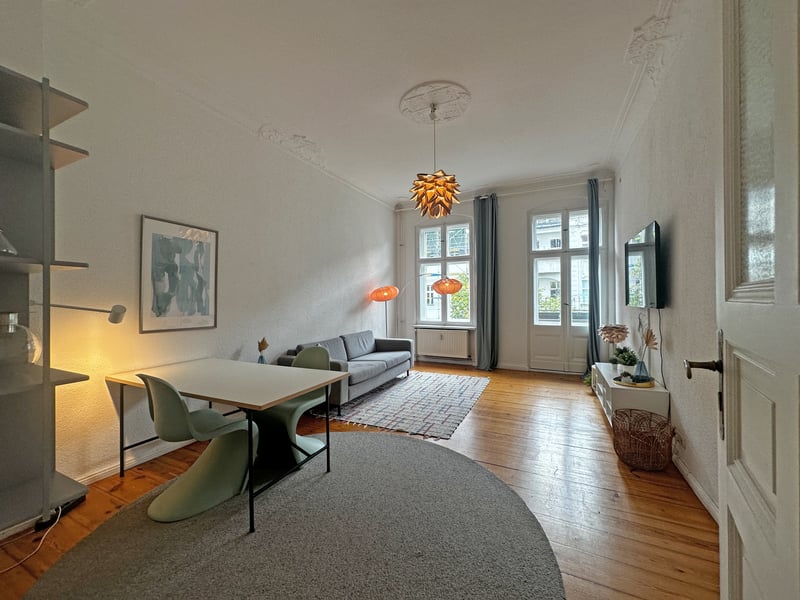
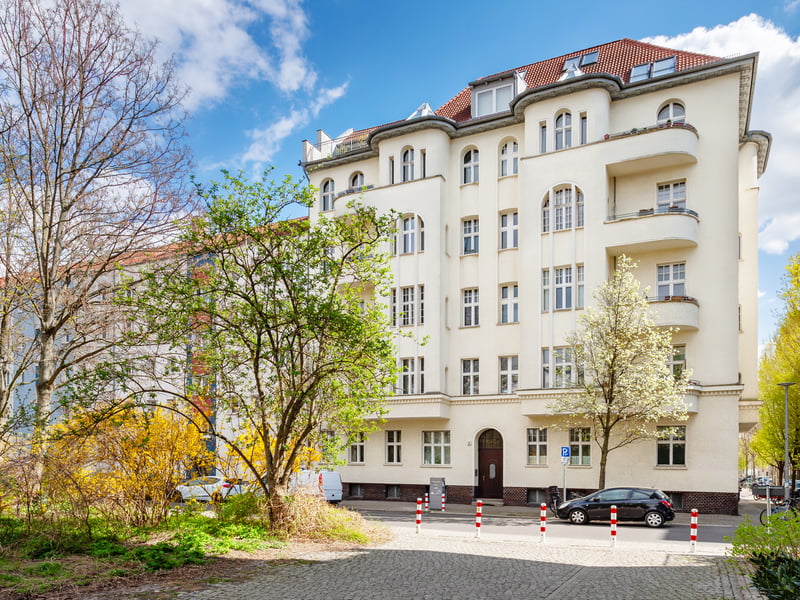
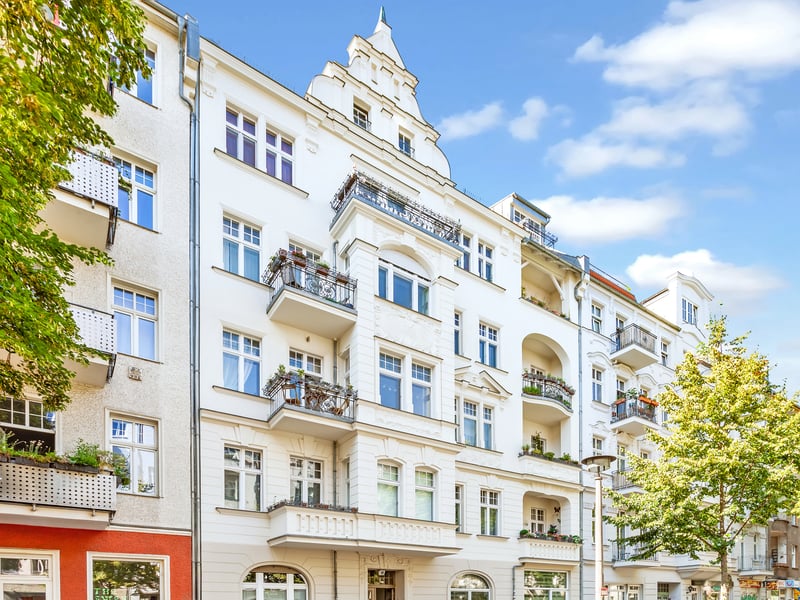
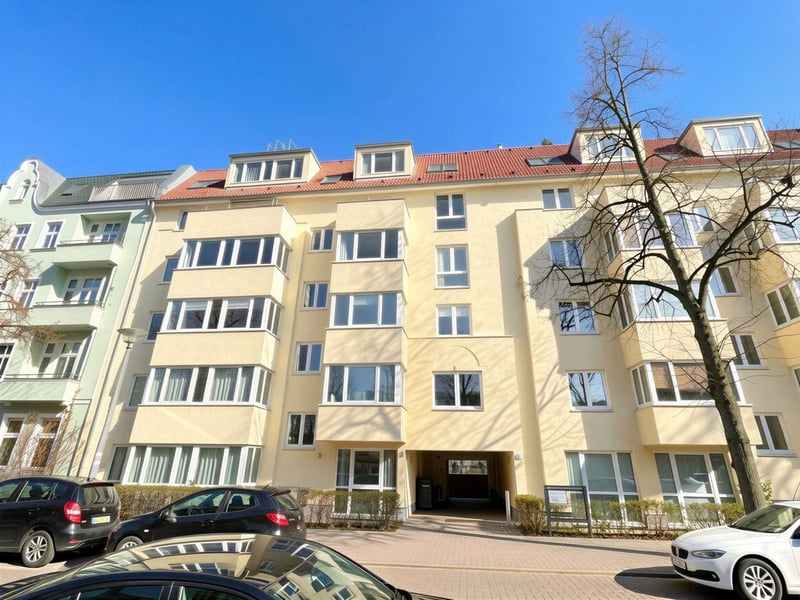
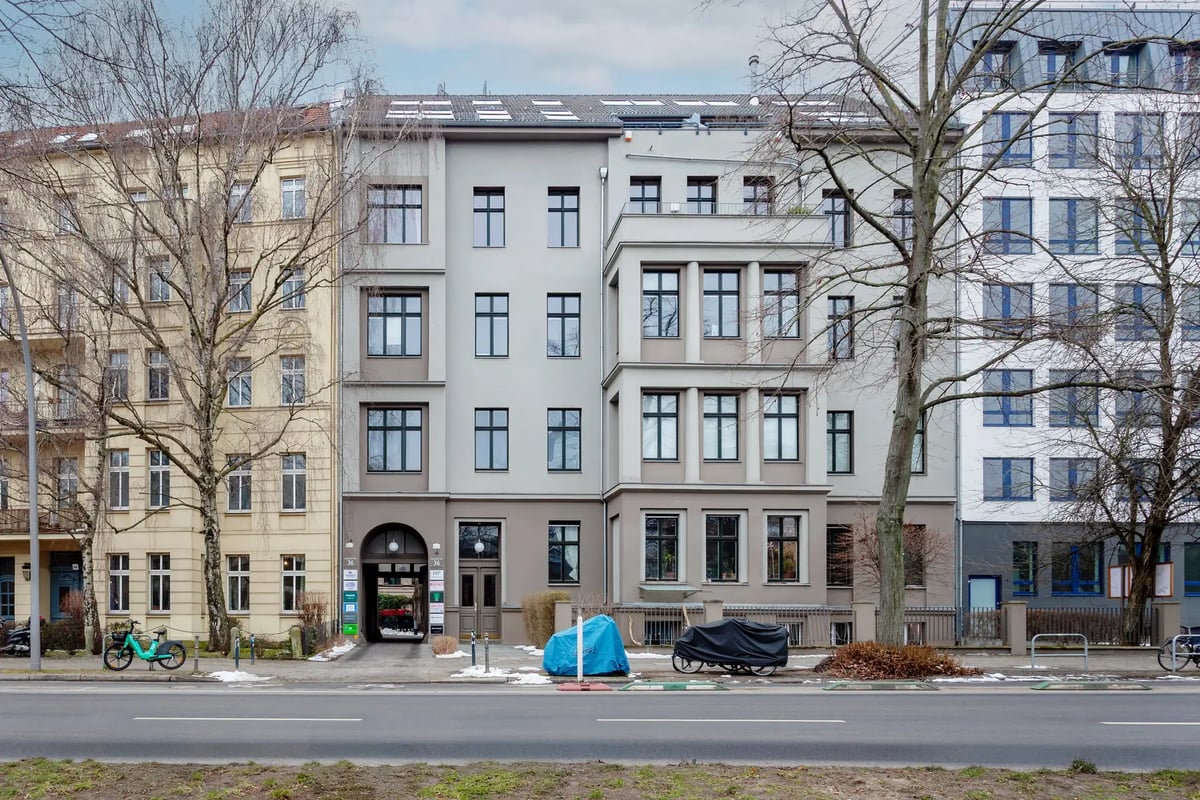
The building stock in Alt-Treptow comprises 551 buildings. It is shaped by rows of period buildings from the Gründerzeit era, supplemented by post-war buildings and newer projects that have arisen mainly on the former commercial sites along the Spree riverbank. Construction periods cannot be presented as a chart from the data, but the picture of a period-building core and selective new development by the water matches the district's structural development.
Among apartment sizes, compact layouts predominate, typical of a period-building quarter. The following overview shows how the stock is distributed across the size classes.
| Size class | Count | Share |
|---|---|---|
| Unter 40 m² | 644 | 9 % |
| 40-59 m² | 2,573 | 36 % |
| 60-79 m² | 2,227 | 32 % |
| 80-99 m² | 992 | 14 % |
| 100-119 m² | 352 | 5 % |
| 120-139 m² | 157 | 2 % |
| 140-159 m² | 72 | 1 % |
| 160-179 m² | 25 | <1 % |
| 180-199 m² | 7 | <1 % |
| 200+ m² | 18 | <1 % |
The use of the stock is also revealing for the social mix. Rented apartments clearly dominate, while ownership is rarer, though it is increasing through new development and conversion by the water.
| Type of use | Count | Share |
|---|---|---|
| Rented | 6,442 | 90 % |
| Owner-occupied | 522 | 7 % |
| Vacant | 102 | 1 % |
| Commercial | 102 | 1 % |
New development in Alt-Treptow arises mainly on the vacated industrial and commercial sites along the Spree, less so in the densely built Kiez core. The following illustration shows how construction activity has developed over time.
| Period | Apartment balance |
|---|---|
| 2021 | -22 apartments |
| 2022 | 68 apartments |
| 2023 | 100 apartments |
| 2024 | 1 apartments |
With a total of 7,060 apartments, Alt-Treptow remains a small-scale apartment market in which larger family-suitable units are in demand.
Transport and infrastructure
The central transport hub of the district is the Treptower Park S-Bahn station. The Ringbahn stops here, connecting Alt-Treptow with the entire inner-city area, alongside further S-Bahn lines towards the inner city and the south-east. From the station you are a few minutes from Ostkreuz, one of Berlin's most important interchange stations, where the Ring, the Stadtbahn and regional services converge. This makes Alt-Treptow very well connected to the rest of the city despite its peripheral setting by the park.
Bus lines complement the S-Bahn and serve the residential streets away from the railway line. Across the Spree bridges, you reach Kreuzberg and the quarters bordering to the north on foot or by bike in a short time, so that many journeys can be made without the railway. For cyclists, the routes along the water and through Treptower Park form a connection into the city of their own, away from the main roads. If you travel by car, you manage more easily in Alt-Treptow than in the dense inner-city Kieze, even though parking space in the residential streets is becoming scarcer.
Local supply is concentrated in the Karl-Kunger-Kiez and along the main streets, with supermarkets, bakeries and small shops close to home. Schools and day-care centres lie within the residential surroundings of the Kiez. The greatest locational advantage is the green provision: with Treptower Park, the adjoining Plänterwald and the Spree with its riverside paths, the district has considerably more greenery and water close to home than most inner-city locations.
Who Alt-Treptow suits
- City-minded nature lovers: If you want park, woodland and the Spree riverbank on your doorstep without giving up proximity to the inner city and good rail connections, you will find a rare combination in Alt-Treptow on the edge of the centre.
- Working people with short journeys: Via the Ringbahn and Ostkreuz, almost the whole city is quickly reachable, which makes the district attractive for commuters within Berlin.
- Families at the park's edge: The broader age structure and the proximity to park and water appeal to households with children seeking larger apartments, of which the period-building stock offers only a limited number.
- Owner-occupiers by the water: The newer buildings on the former commercial sites along the Spree riverbank are aimed at buyers for whom the setting by water and park matters; Milieuschutz regulates conversion and modernisation in the existing stock here.