

Character and identity
Prenzlauer Berg is the south-western district of the borough of Pankow, with an area of 11.04 km². On this comparatively small area stand 7,673 buildings with 95,441 apartments, in which 169,856 residents live in 93,133 households. That makes the district one of the most densely built quarters in the city.
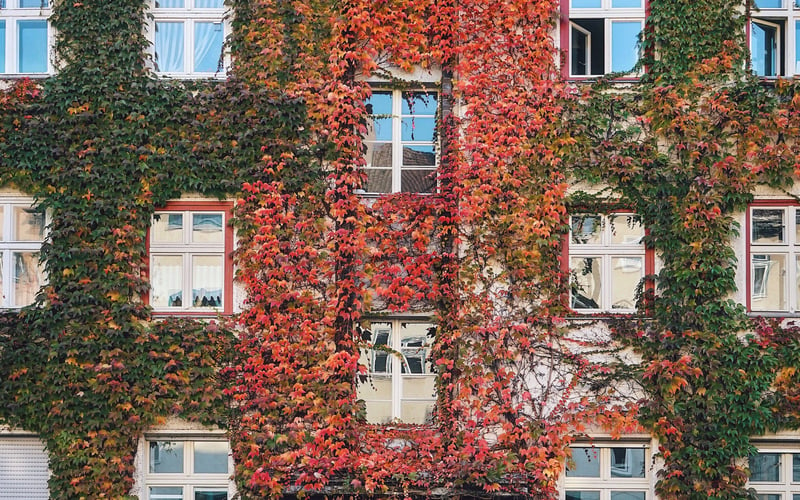
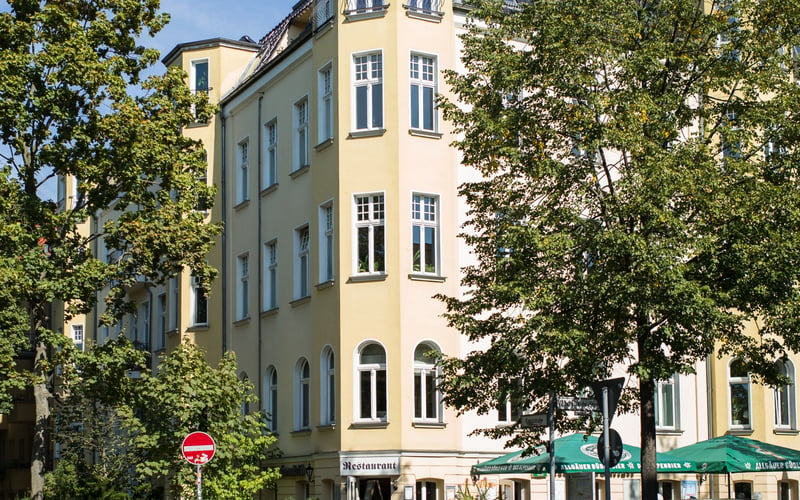
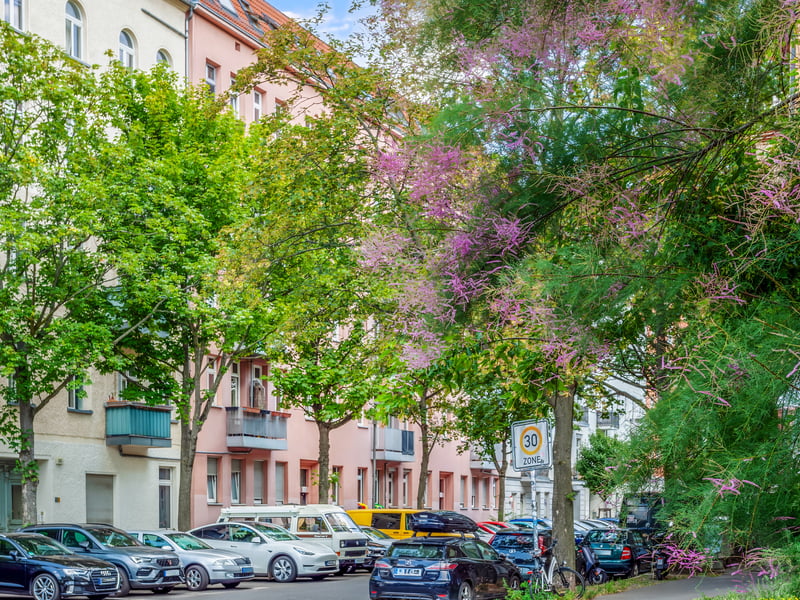
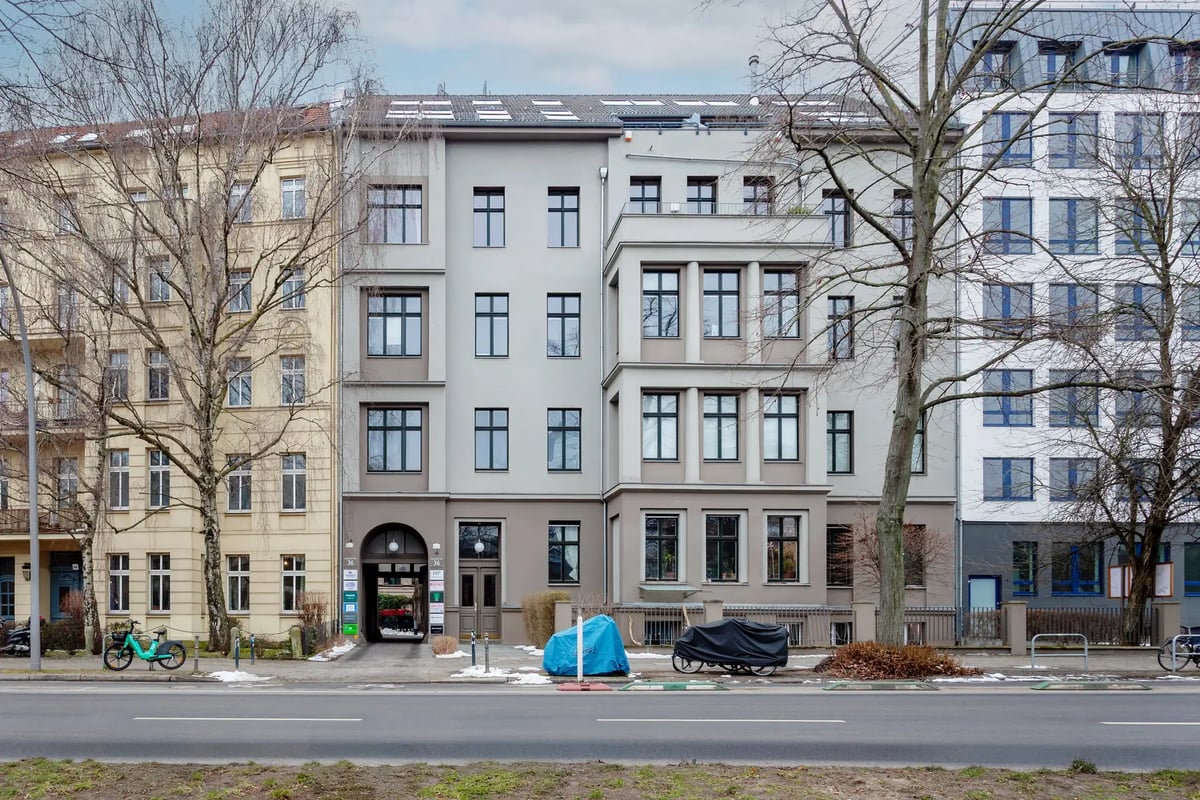
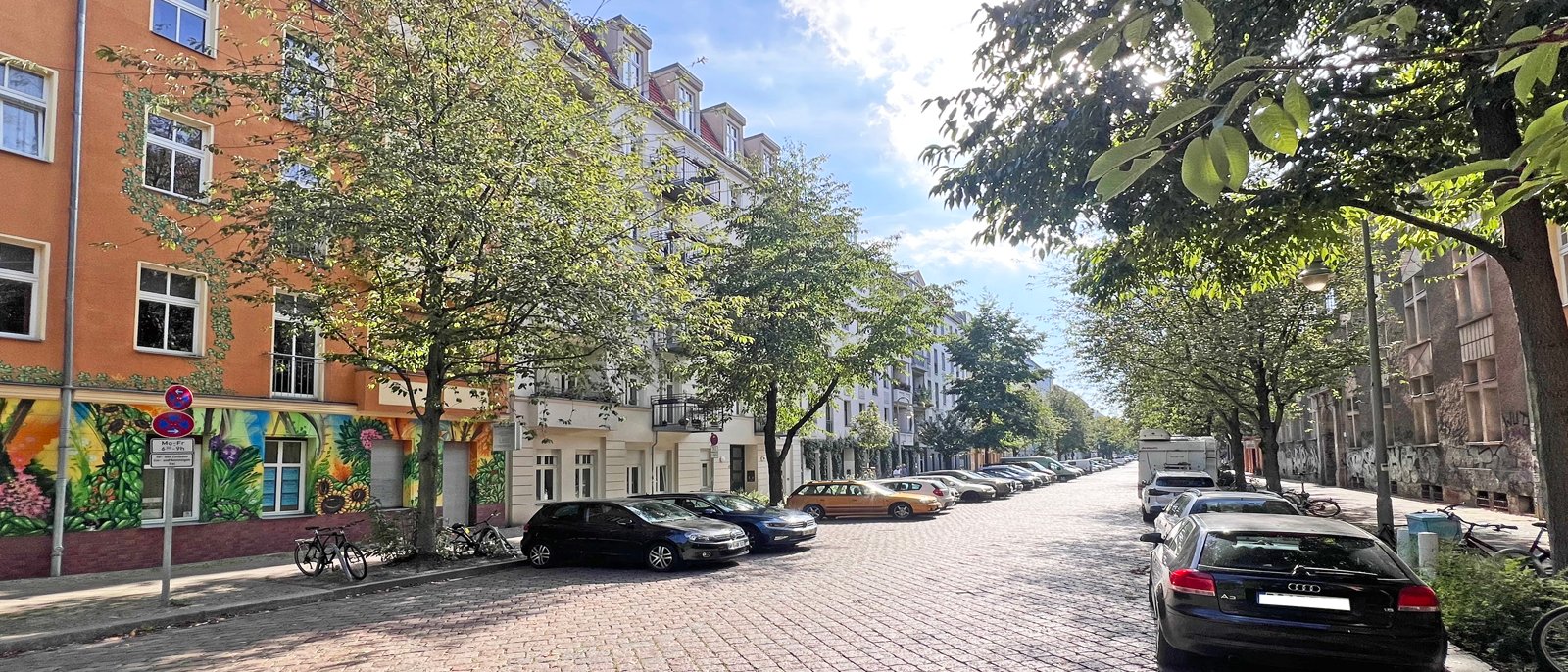
Walking through Prenzlauer Berg, you first see the facades. Closed streetscapes from the Gründerzeit, stucco, high ceilings, green courtyards. The district came through the Second World War with large parts of its period building stock intact, unlike many inner-city areas of West Berlin. This structural continuity still shapes the picture today: hardly any breaks in the street space, but an almost continuous perimeter block development with ground floors full of cafés, shops and practices.
The second impression is social in nature. At the Kollwitzplatz children play, while at the tables in front of it English, Spanish and German mingle. A few streets away, on the Kastanienallee, which Berliners have long called „Castingallee“, sits a different crowd. Prenzlauer Berg carries both, the bourgeois and the scene-driven, the young family and the Berlin newcomers from overseas. This mix is not new, it is the result of thirty years of change.
Administratively, the district has been part of Pankow since the territorial reform of 2001. It borders Pankow and Weißensee to the north, Lichtenberg to the east, Friedrichshain to the south, and the districts of Mitte and Gesundbrunnen to the west. These neighbourhoods are no coincidence, they explain much about the movements that shape the district to this day.
History and change
Prenzlauer Berg took its present form between the 1870s and 1900s, when the growing industrial city of Berlin needed working-class quarters. It was built densely, with front building, side wing and rear building, courtyard upon courtyard. For decades this was a quarter of ordinary people, not an affluent middle-class area.
In the GDR the stock fell into neglect. The state preferred to invest in the prefab housing estates of Marzahn and Hellersdorf rather than renovate the period buildings. Well into the 1990s many apartments were heated with coal stoves, and toilets lay half a flight of stairs below. Thousands of apartments stood empty, whole buildings decayed. At the same time the decay attracted a particular crowd: artists, dropouts, an East-Berlin bohemia that the Stasi found suspect. The Gethsemanekirche on the Stargarder Straße became a meeting point of the civil rights movement in the autumn of 1989 and one of the places where the political upheaval came to a head.
With the fall of the Wall came the break. Hundreds of dilapidated apartment buildings were renovated, often with subsidies and tax incentives. Within a few years the run-down East-Berlin quarter became a place of longing for newcomers from all over Germany and soon from abroad. From the single scene district, smaller, independent Kieze gradually emerged, each with its own pace and crowd.
This change reassembled the district socially without destroying it structurally. Where other Berlin quarters were demolished and rebuilt across whole areas, here the substance remained and the residents changed. Today a large part of the district lies in conservation areas under § 172 of the Baugesetzbuch, the so-called milieu protection, which regulates structural changes and conversions. The change that shaped Prenzlauer Berg is thus politically contained, but not ended.
Sights
The best-known landmark stands at the edge of the Kollwitzkiez: the Wasserturm on the Knaackstraße, one of the oldest in Berlin, a round brick building on a small rise. A few minutes away lies the synagogue on the Rykestraße, the largest synagogue in Germany, which survived both the Nazi era and the GDR.
The Kulturbrauerei on the Schönhauser Allee is the cultural heavyweight of the district. The listed ensemble of a former brewery today houses cinemas, concert halls, a museum on everyday life in the GDR, and a weekly and Christmas market. The history of the quarter is also represented by the Gethsemanekirche and the Zionskirche, both closely tied to the church opposition of the late GDR, as well as the Jewish cemetery on the Schönhauser Allee.
In the east of the district lies the Ernst-Thälmann-Park, a residential and green complex from the 1980s with the Zeiss-Großplanetarium, one of the most modern planetariums in Europe. The transition to the district of Gesundbrunnen is marked by the Mauerpark, laid out on the former border strip. It is less a sight than a stage, more on that shortly.
Popular Kieze in Prenzlauer Berg
Prenzlauer Berg is not one block but a series of Kieze, each with its own character:
- Kollwitzkiez: around the Kollwitzplatz, named after the artist Käthe Kollwitz. Renovated middle class, a weekly market, a high density of cafés and boutiques.
- Bötzowviertel: a quiet residential quarter by the Volkspark Friedrichshain, popular with families. Here lies the Kurt-Schwitters-Schule, one of the largest schools in Berlin.
- Helmholtzkiez: around the Helmholtzplatz, younger and denser, with a pronounced restaurant and nightlife scene. The adjoining „LSD-Viertel“ made up of Lychener Straße, Schliemannstraße and Dunckerstraße is among the liveliest corners.
- Gleimviertel: by the Mauerpark and on the border with Gesundbrunnen, shaped by the proximity to the former border strip and an international crowd.
- Arnimkiez: residential areas with a mixed population between the Schönhauser Allee and the Prenzlauer Allee.
- Quarters along the Greifswalder Straße: more strongly shaped by traffic, with transitions towards Friedrichshain and Weißensee.
Scene and everyday life
Everyday life in Prenzlauer Berg plays out on the squares and along a few main axes. The Kollwitzplatz hosts one of the best-known weekly markets in the city, with a focus on regional and organic producers. The Schönhauser Allee is the supply and shopping axis, the elevated railway runs above, and below it Konnopke's Imbiss, a currywurst institution under the viaduct, has stood for decades.
At the weekend the centre shifts to the Mauerpark. The flea market draws an international crowd, and in the summer amphitheatre the open-air karaoke takes place, known far beyond Berlin. The Kastanienallee bundles fashion, bars and street life, and the Oderberger Straße connects it with the Mauerpark.
Away from the well-known axes, the district thrives on small-scale gastronomy, owner-run shops, galleries and small fringe stages. Around the Helmholtzplatz the nightlife concentrates, while in the side streets of the Bötzow- and Kollwitzviertel a bourgeois, almost small-town pace prevails. This simultaneity of bustle and calm, often just a street corner apart, is typical of the district.
Who lives in Prenzlauer Berg
At the end of 2025 Prenzlauer Berg counted around 169,900 residents (Amt für Statistik Berlin-Brandenburg). The share of foreign nationals is just under 25 percent, the share of people with a migration background around 38 percent. That makes the district more international than its bourgeois image suggests.
| Age group | Count | Share |
|---|---|---|
| under 6 | 8,006 | 5 % |
| 6–15 | 13,139 | 8 % |
| 15–18 | 4,551 | 3 % |
| 18–27 | 16,670 | 10 % |
| 27–45 | 61,427 | 36 % |
| 45–55 | 27,148 | 16 % |
| 55–65 | 21,524 | 13 % |
| 65+ | 17,391 | 10 % |
The age structure is striking. With a good 61,000 people, the group of 27- to 44-year-olds makes up more than a third of the population, a very high value for Berlin. Children under 15 account for about 12 percent, the 65-plus generation around 10 percent. Prenzlauer Berg is therefore not a classic family quarter in the statistical sense, but above all a quarter of the middle working-age groups, supplemented by a visible but numerically limited number of children.
| Household size | Count | Share |
|---|---|---|
| 1 person | 58,985 | 63 % |
| 2 people | 17,868 | 19 % |
| 3 people | 8,608 | 9 % |
| 4 people | 5,381 | 6 % |
| 5 people | 1,307 | 1 % |
| 6+ people | 984 | 1 % |
This becomes even clearer when you look at the households. Almost two thirds of all households are single-person households (Census 2022). Families with three or more people together make up less than a fifth. The image of prams at the Kollwitzplatz is therefore accurate, but describes a minority. The majority of the district consists of singles and couples, many of them in the large period apartments that were originally intended for families.
| Region of origin | Count | Share |
|---|---|---|
| EU | 22,728 | 48 % |
| Ukraine | 3,782 | 8 % |
| USA | 3,424 | 7 % |
| Russia | 3,365 | 7 % |
| United Kingdom | 2,509 | 5 % |
| Turkey | 2,399 | 5 % |
| India | 2,054 | 4 % |
| Vietnam | 1,942 | 4 % |
| Syria | 1,604 | 3 % |
| unassigned | 1,120 | 2 % |
| Iran | 742 | 2 % |
| China | 643 | 1 % |
| Afghanistan | 619 | 1 % |
| Kazakhstan | 358 | <1 % |
| Lebanon | 293 | <1 % |
| Iraq | 241 | <1 % |
The international character can be read in the regions of origin. Behind the EU as the largest group come Ukraine, the USA, the Russian Federation, the United Kingdom and Turkey. That is a different mix from many West-Berlin boroughs, more western and eastern European, with a striking Anglo-American component that explains the abundant English in the cafés.
Who is drawn to Prenzlauer Berg
The migration data show a district in constant motion. Across the city border, Prenzlauer Berg lost people on balance to the rest of the country in 2024. Those who leave Berlin often move to the surrounding region or back to their old home, frequently when family and the need for space grow. Against this loss stands an international influx that keeps the district stable in numerical terms. The following table shows the most important countries of origin with arrivals and departures across the city border (Amt für Statistik Berlin-Brandenburg).
| # | Country | Inflow | Outflow | Net |
|---|---|---|---|---|
| 1 | Indien | 441 | 178 | 263 |
| 2 | Italien | 287 | 249 | 38 |
| 3 | Vereinigte Staaten | 260 | 234 | 26 |
| 4 | Ukraine | 258 | 213 | 45 |
| 5 | Russische Föderation | 242 | 85 | 157 |
| 6 | Türkei | 235 | 123 | 112 |
| 7 | Frankreich | 171 | 146 | 25 |
| – | Deutschland | 3,211 | 3,985 | -774 |
The top entry is remarkable: the strongest net inflow now comes from India, ahead of the Russian Federation and Turkey. The district is thus increasingly drawing qualified migration from the technology and science sector, a pattern that is also visible in other inner-city locations and that complements the older picture of a mainly Anglo-American influx.
Within Berlin, the exchange is above all small-scale. Most arrivals come from the neighbouring inner-city areas.
| # | District | People |
|---|---|---|
| 1 | Friedrichshain | 995 |
| 2 | Mitte | 980 |
| 3 | Wittenau | 783 |
| 4 | Tegel | 688 |
| 5 | Kreuzberg | 550 |
Friedrichshain and Mitte clearly lead, followed by Kreuzberg and Neukölln. It is an exchange within the inner ring, in which above all younger people move between the sought-after period-building quarters.
In the opposite direction, Prenzlauer Berg loses above all to the greener neighbours within its own borough.
| # | District | People |
|---|---|---|
| 1 | Friedrichshain | 959 |
| 2 | Mitte | 810 |
| 3 | Weißensee | 552 |
| 4 | Kreuzberg | 531 |
| 5 | Pankow | 529 |
To Weißensee and Pankow, significantly more people move away than come from there. That is the typical movement of starting a family. Those who seek more square metres and a bit of garden often stay within the borough, but move a few kilometres north.
Buildings and apartments
The housing stock of Prenzlauer Berg is strongly shaped by the Gründerzeit. More than three quarters of the buildings are terraced, that is, the closed perimeter block development that defines the streetscape. Detached houses and semi-detached houses are the exception. This structural uniformity explains why the district feels so coherent.
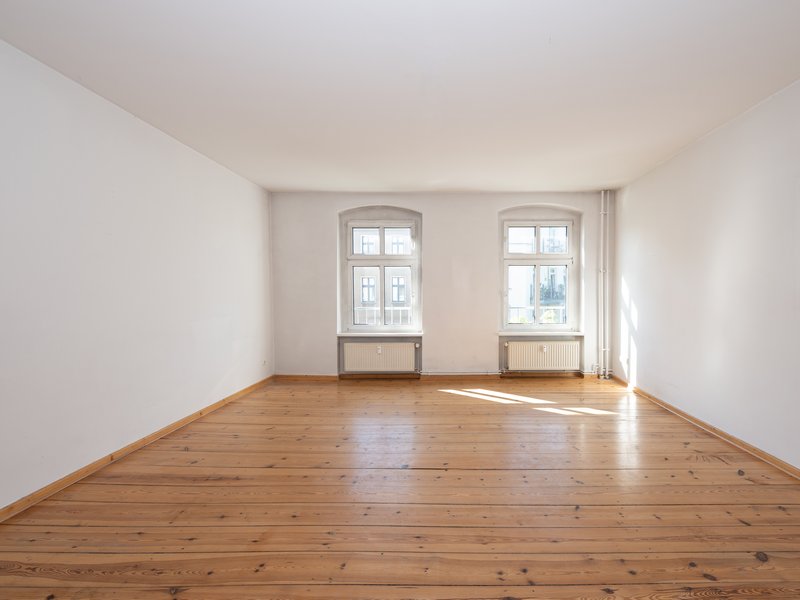
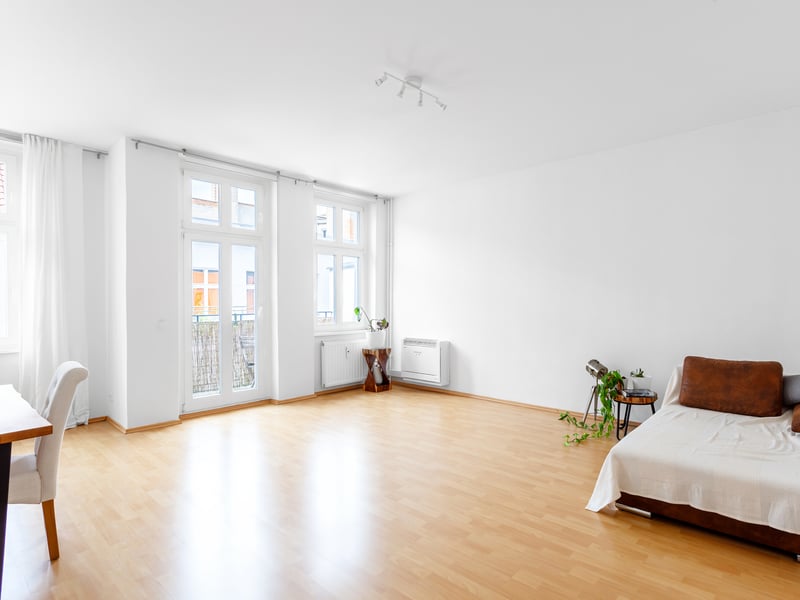
Among the apartment sizes, the middle segment dominates. Around 61 percent of all apartments lie between 40 and 79 m² (Census 2022), apartments under 40 m² make up about 12 percent, and very large apartments over 120 m² only around 6 percent. The widespread impression that Prenzlauer Berg consists mainly of large period apartments therefore applies only to a part. More characteristic are the classic two- to three-room period flats, today often occupied by one or two people.
| Size class | Count | Share |
|---|---|---|
| Unter 40 m² | 11,050 | 12 % |
| 40-59 m² | 32,027 | 34 % |
| 60-79 m² | 26,218 | 27 % |
| 80-99 m² | 13,216 | 14 % |
| 100-119 m² | 7,067 | 7 % |
| 120-139 m² | 3,123 | 3 % |
| 140-159 m² | 1,343 | 1 % |
| 160-179 m² | 675 | <1 % |
| 180-199 m² | 292 | <1 % |
| 200+ m² | 424 | <1 % |
The use of the stock is also revealing: Prenzlauer Berg is predominantly a rental market, and owner-occupied property remains the exception.
| Type of use | Count | Share |
|---|---|---|
| Rented | 84,227 | 86 % |
| Owner-occupied | 9,296 | 10 % |
| Vacant | 1,744 | 2 % |
| Commercial | 2,352 | 2 % |
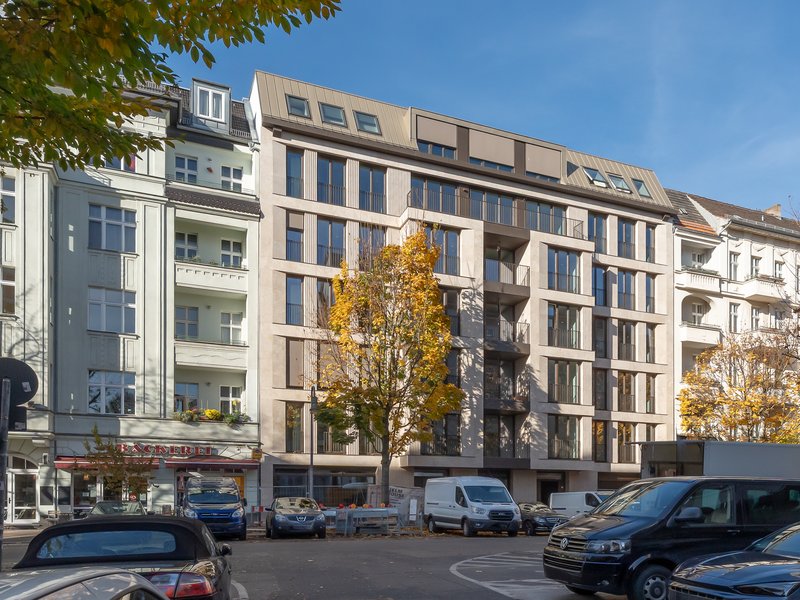
The construction periods range from the peak of the Gründerzeit through scattered post-war gaps to the housing complexes of the late GDR, for example around the Ernst-Thälmann-Park. New development is rare in the densely built district and concentrates on loft conversions, building gaps and individual conversion sites such as the grounds of the old slaughterhouse in the north-east. Where modernisation happens, milieu protection sets tight limits in the conservation areas.
| Period | Apartment balance |
|---|---|
| 2021 | 650 apartments |
| 2022 | 708 apartments |
| 2023 | 265 apartments |
| 2024 | 291 apartments |
Transport and infrastructure
Prenzlauer Berg is well connected without having a large transport hub of its own. The U-Bahn line U2 crosses the district with the stations Senefelderplatz, Eberswalder Straße and Schönhauser Allee. The last is at the same time an interchange to the S-Bahn, as the Ring touches the district in the west and north with the stations Schönhauser Allee, Bornholmer Straße, Prenzlauer Allee, Greifswalder Straße and Landsberger Allee.
The real backbone of local transport, however, is the tram. The lines M1, M2, M10 and 12 connect the residential streets with Mitte, the Hauptbahnhof and the neighbouring boroughs, and the M10 along the Bernauer Straße has become a well-known cross connection. The network is among the densest in the city. Those who cycle make quick progress in the flat, well-connected district, even if the main axes such as the Schönhauser and Greifswalder Allee remain heavily trafficked.
The amenities are dense. The Schönhauser Allee with the Schönhauser Allee Arcaden forms the shopping centre, supplemented by small-scale local supply in almost every residential street. Among schools the district is one of the most sought-after in the city, and the Kurt-Schwitters-Schule in the Bötzowviertel is one of the largest in Berlin. For sport, the Friedrich-Ludwig-Jahn-Sportpark and the Velodrom provide two larger facilities. When it comes to green space, however, Prenzlauer Berg fares worse than northern Pankow: larger areas are offered above all by the Mauerpark, the Ernst-Thälmann-Park and the Volkspark Prenzlauer Berg, a rubble hill in the north-east piled up after the war. Water areas are rare.
Who Prenzlauer Berg suits
- International skilled and knowledge migrants: The strongest international influx in the borough, an Anglo-American community and short distances to Mitte; it suits the dominant age group of 27- to 44-year-olds. The middle apartment segment is scarce and in strong demand.
- Single-person households and couples: Almost two thirds of households consist of one person, and the supply between 40 and 79 m² fits exactly. The later jump to larger apartments is rare in the district.
- Families with ties to the borough: The Kollwitz- and Bötzowkiez offer a child-friendly environment with established schools and daycare centres; but as they grow, many families move out to Weißensee and Pankow, as large apartments are scarce.
- Buy-and-hold owners and investors: A homogeneous Gründerzeit stock, an established location and demand that has been stable for decades. Large parts lie in milieu protection areas, which limits remodelling and conversion.