

Character and identity
Wilmersdorf is a bourgeois district in the west of Berlin and, together with Charlottenburg, forms the core of the borough of Charlottenburg-Wilmersdorf. Across roughly 7.2 km², it is home to 99,310 residents. The stock is spread across 57,848 apartments and 56,092 households in 4,475 buildings (source: Amt für Statistik Berlin-Brandenburg).
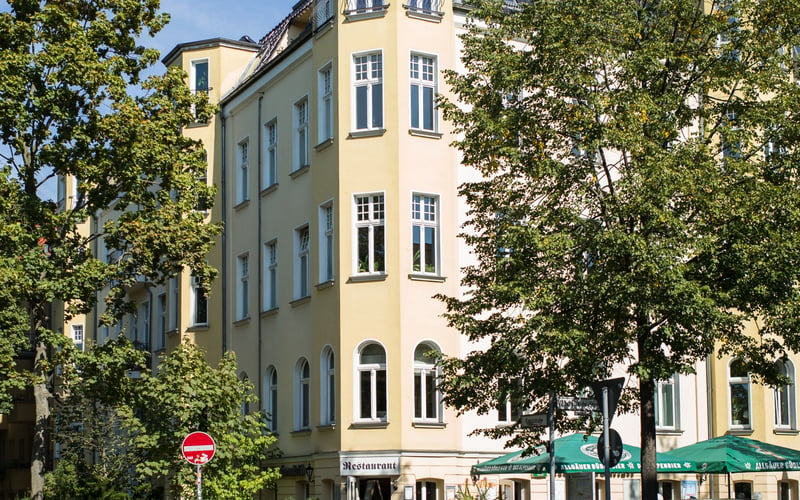
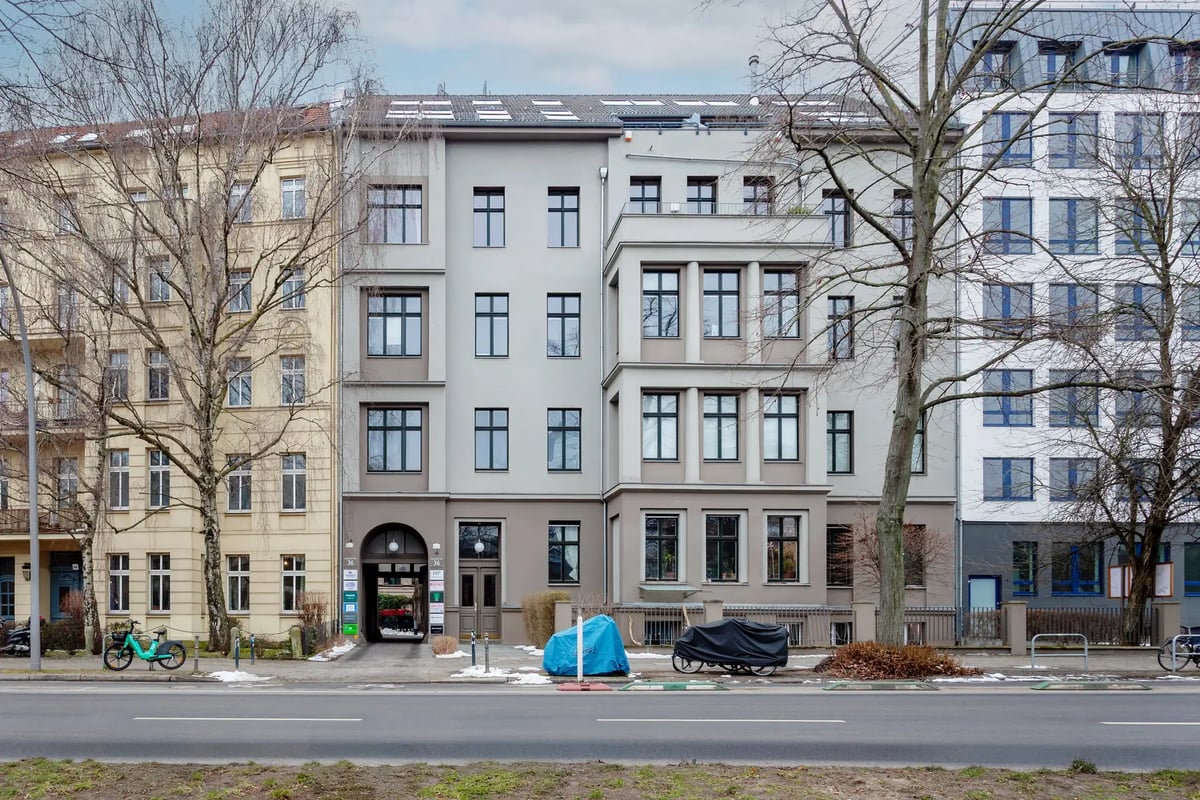
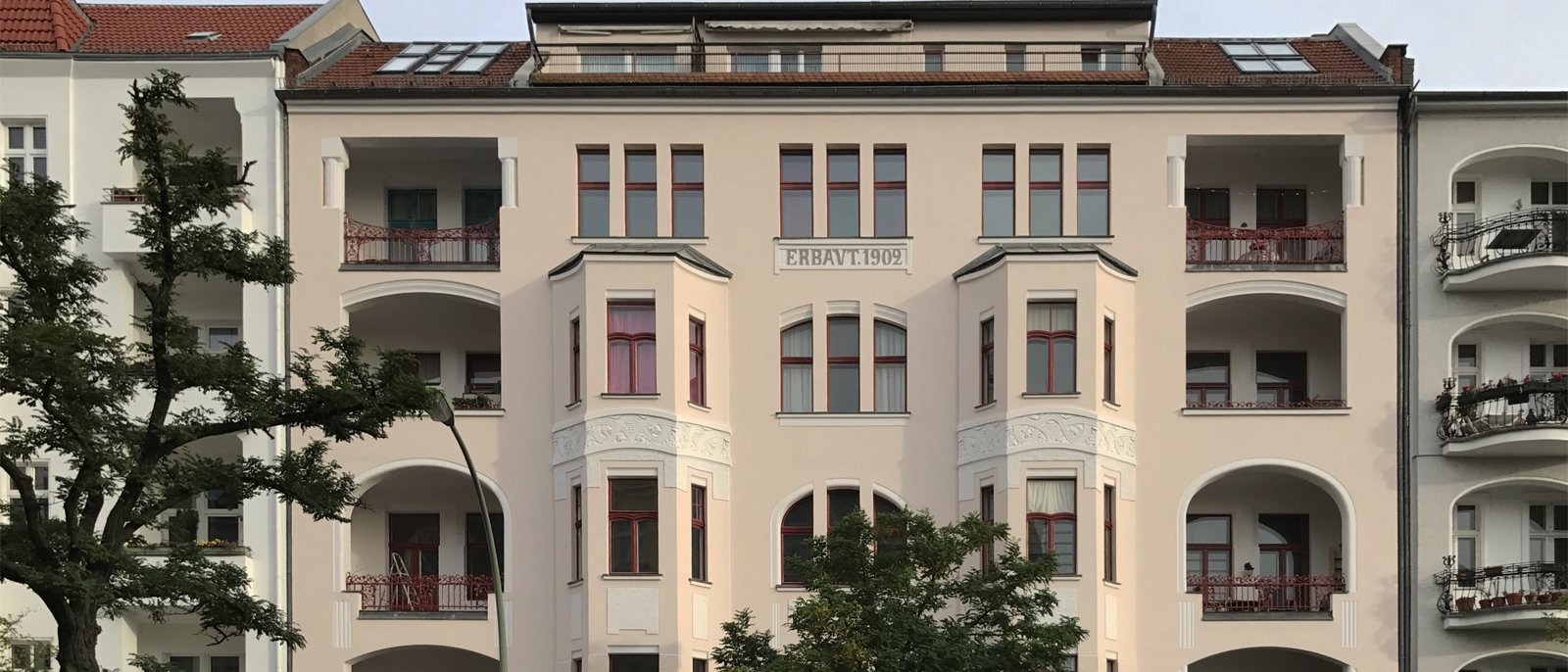
The district is defined by closed Wilhelminian-era quarters with wide residential streets, stately period facades and spacious apartments. To the north, Wilmersdorf reaches the Kurfürstendamm and with it the City West, while to the south and east the built-up area runs across the Volkspark Wilmersdorf and along the Ringbahn towards the neighbouring districts. Unlike the inner-city quarters in the east of Berlin, Wilmersdorf is less a nightlife district than a place to live, quieter in tone and more focused on residential quality, local supply and short distances.
Between the residential blocks lie squares that give the district its rhythm. Ludwigkirchplatz with its cafés, Rüdesheimer Platz in the Rheingauviertel, the monumental Fehrbelliner Platz and the green Preußenpark with its well-known Thai food market are the fixed points of daily life. The mix of dense, well-kept building stock and continuous green corridors explains why Wilmersdorf has ranked among the sought-after residential areas in the west for decades.
History and change
For centuries, Wilmersdorf was a village green settlement outside the gates of Berlin. Its rural origin is still marked by the Wilhelmsaue, the historic street around the former village green, where the Schoeler-Schlösschen from the mid-18th century stands as the oldest surviving building in the district. The neo-Gothic Auenkirche of 1897 closed the rural chapter, by which time the building boom had long since overtaken the village.
With industrialisation, Deutsch-Wilmersdorf grew into a city within a few decades. Land speculation and an affluent resident population made the municipality one of the wealthiest towns in Prussia around 1900. Wilmersdorf received town rights in 1906 and was incorporated into Greater Berlin as its own borough in 1920. In the 1920s, artists and intellectuals were drawn to Berlin's west, which with its cafés, theatres and proximity to genteel Grunewald served as an address for the bohemian scene. Wilmersdorf also had a large Jewish population; Nazi persecution ended the cultural heyday and forced many residents into exile or death, commemorated today by numerous Stolpersteine.
The Nazi era also left its architectural mark at Fehrbelliner Platz, whose monumental administrative buildings were erected from the mid-1930s and today house the borough office and public authorities. The Second World War destroyed large parts of the quarters. Reconstruction was carried out with limited means and followed the model of the car-friendly city for years, visible in the widening of the Bundesallee into a broad traffic artery. In the 1970s, many squares and residential areas were upgraded again. In 2001, the boroughs of Wilmersdorf and Charlottenburg merged into today's Charlottenburg-Wilmersdorf.
Sights
The northern edge of Wilmersdorf belongs to the Kurfürstendamm. At Lehniner Platz stands the Schaubühne, one of Berlin's best-known theatres, housed in the former Universum cinema designed by Erich Mendelsohn in 1928. A few steps further, Olivaer Platz opens up as a green point of calm right on the shopping boulevard.
Perhaps the most idiosyncratic landmark is the Preußenpark, which Berliners know as the Thai Park. What began as an informal lawn with Thai food stalls became a regulated market that draws people from across the city on warm weekends and gives Wilmersdorf a culinary feature no other district has. To the east, the Volkspark Wilmersdorf with the Fennsee runs as a long green corridor through the district.
Architecturally, the Berlin Mosque on Brienner Straße stands out, built between 1924 and 1928 in the Mughal style and the oldest surviving mosque in Germany. Rüdesheimer Platz in the Rheingauviertel, with its wine fountain and summer wine service, was laid out in the English country house style. In 2015, the New York Times counted the adjacent Rüdesheimer Straße among the most scenic streets in Europe. Add to this the Stadtbad Wilmersdorf as a classic public bath and the quiet square ensembles at Ludwigkirchplatz and Prager Platz.
Popular Kieze in Wilmersdorf
- Rheingauviertel: Around Rüdesheimer Platz, planned in the English country house style, with spacious period apartments in four-storey buildings and a strong sense of neighbourhood life.
- Ludwigkirchplatz: A café and residential quarter centred on the Catholic St Ludwig church, valued for its quiet, upscale atmosphere between the Ku'damm and the Volkspark.
- Prager Platz: A restored square with period and post-war buildings, a dense residential quarter with good local supply.
- Bundesplatz and Bundesallee: A solidly middle-class residential area mixing period buildings with 1950s stock, shaped by the busy axis of the Bundesallee.
- Fehrbelliner Platz and Hohenzollerndamm: An administrative and residential location with the striking 1930s architecture and one of the district's most important transport hubs.
- Wilhelmsaue: The historic village core with the Auenkirche and the Schoeler-Schlösschen, small-scale and quiet amid the dense city.
Scene and everyday life
Social life in Wilmersdorf is neighbourly rather than nocturnal. Ludwigkirchplatz with its cafés and restaurants is a meeting point throughout the day, as are the venues around Rüdesheimer Platz, where summer wine service at the fountain is a tradition. The Thai food market in the Preußenpark brings its own international atmosphere to the district on weekends.
Shopping and strolling shift to the edges: the Kurfürstendamm with its retail borders directly, while Blissestraße, Berliner Straße and the Bundesallee handle everyday supply within the quarter. Culturally, the Schaubühne at Lehniner Platz sets the tone, complemented by galleries and smaller stages. Anyone looking for more activity reaches the City West or Schöneberg quickly via the neighbouring districts.
Who lives in Wilmersdorf
Wilmersdorf is strongly shaped by small households. The distribution by household size shows how clearly one-person households define the district.
| Household size | Count | Share |
|---|---|---|
| 1 person | 36,366 | 65 % |
| 2 people | 11,189 | 20 % |
| 3 people | 4,399 | 8 % |
| 4 people | 2,777 | 5 % |
| 5 people | 761 | 1 % |
| 6+ people | 600 | 1 % |
Around two thirds of all households consist of a single person, while larger households of four or more remain the exception. This fits the age structure, which is above the Berlin average: alongside a strong group of 27- to 45-year-olds, the over-65 generation makes up a notably high share of the resident population.
| Age group | Count | Share |
|---|---|---|
| under 6 | 4,294 | 4 % |
| 6–15 | 6,665 | 7 % |
| 15–18 | 2,219 | 2 % |
| 18–27 | 9,913 | 10 % |
| 27–45 | 27,249 | 27 % |
| 45–55 | 11,152 | 11 % |
| 55–65 | 14,084 | 14 % |
| 65+ | 23,734 | 24 % |
This mix of a working-age core and a large number of older residents explains the quiet, established character of the district. At the same time, Wilmersdorf is international. Among residents with a migration background, the European Union forms the largest group, followed by Turkey, Ukraine and the Russian Federation. Notable by Berlin standards is the strong presence from the USA, in keeping with the western, cosmopolitan character of the location.
| Region of origin | Count | Share |
|---|---|---|
| EU | 12,285 | 38 % |
| Turkey | 3,214 | 10 % |
| Ukraine | 3,054 | 9 % |
| Russia | 2,652 | 8 % |
| unassigned | 2,254 | 7 % |
| USA | 1,380 | 4 % |
| India | 1,342 | 4 % |
| Syria | 1,309 | 4 % |
| Iran | 1,223 | 4 % |
| China | 1,060 | 3 % |
| United Kingdom | 715 | 2 % |
| Vietnam | 580 | 2 % |
| Afghanistan | 472 | 1 % |
| Lebanon | 467 | 1 % |
| Kazakhstan | 308 | <1 % |
| Iraq | 223 | <1 % |
Who is drawn to Wilmersdorf
The migration data show where Wilmersdorf gains its residents and where they move on. Across the city border, international arrivals carry the growth, while in the exchange with the rest of Germany the district sees a net outflow.
| # | Country | Inflow | Outflow | Net |
|---|---|---|---|---|
| 1 | Arabische Republik Syrien | 551 | 140 | 411 |
| 2 | Türkei | 450 | 180 | 270 |
| 3 | Ukraine | 363 | 234 | 129 |
| 4 | Afghanistan | 315 | 112 | 203 |
| 5 | Indien | 312 | 148 | 164 |
| 6 | Russische Föderation | 143 | 93 | 50 |
| 7 | Libyen | 140 | 114 | 26 |
| – | Deutschland | 1,761 | 2,151 | -390 |
The strongest inflow from abroad comes from Syria, followed by Turkey and Ukraine; many people also arrive from Afghanistan and India. Within Berlin, the exchange is closely tied to the west. Most newcomers come from neighbouring Charlottenburg and from Schöneberg, along with Kreuzberg and Neukölln.
| # | District | People |
|---|---|---|
| 1 | Charlottenburg | 713 |
| 2 | Schöneberg | 573 |
| 3 | Kreuzberg | 297 |
| 4 | Neukölln | 252 |
| 5 | Steglitz | 230 |
The movement runs similarly in the other direction. Those who leave Wilmersdorf mostly stay in the west and move to Charlottenburg or Schöneberg, but often also further into the greener south-west to Steglitz, Lichterfelde, Westend and Schmargendorf. This pattern traces a classic life cycle: starting out central and urban in Wilmersdorf, then moving on to the quieter parts of the borough as families grow.
| # | District | People |
|---|---|---|
| 1 | Charlottenburg | 743 |
| 2 | Schöneberg | 467 |
| 3 | Kreuzberg | 365 |
| 4 | Steglitz | 286 |
| 5 | Neukölln | 278 |
Buildings and apartments
The housing stock is one of the district's hallmarks. Wilmersdorf ranks among the highest in Berlin for average apartment size, which is reflected in the distribution by floor-area class.
| Size class | Count | Share |
|---|---|---|
| Unter 40 m² | 6,362 | 11 % |
| 40-59 m² | 16,751 | 29 % |
| 60-79 m² | 16,303 | 28 % |
| 80-99 m² | 7,884 | 14 % |
| 100-119 m² | 4,144 | 7 % |
| 120-139 m² | 2,668 | 5 % |
| 140-159 m² | 1,489 | 3 % |
| 160-179 m² | 1,032 | 2 % |
| 180-199 m² | 477 | <1 % |
| 200+ m² | 759 | 1 % |
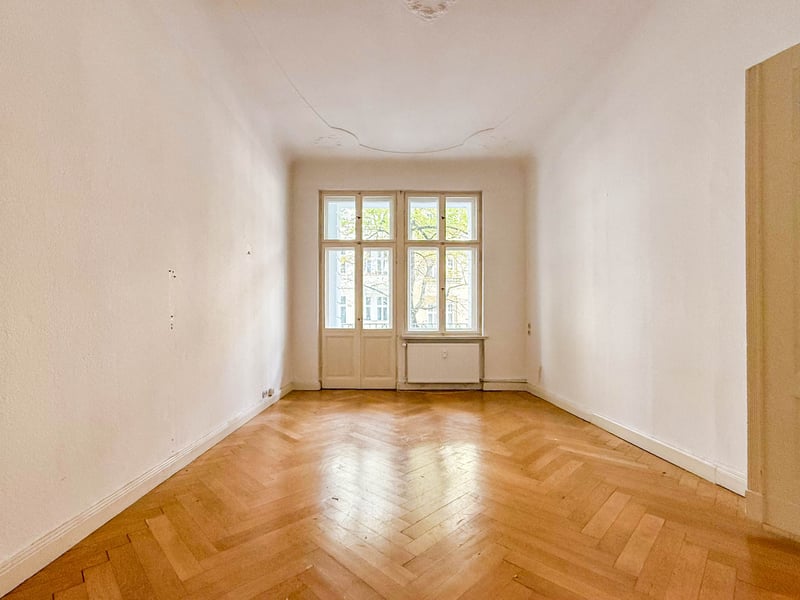
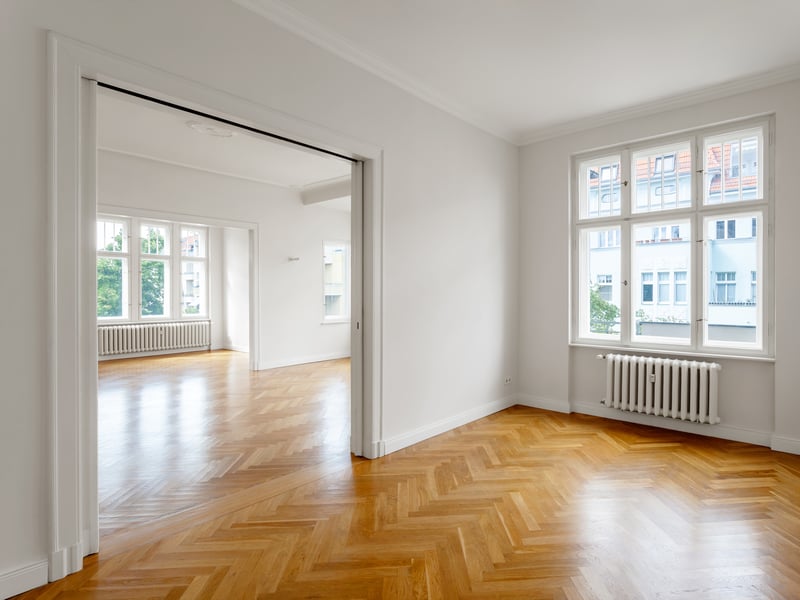
Large, stately period apartments from the Wilhelminian era define the stock, especially in the quarters around Ludwigkirchplatz, Olivaer Platz and in the Rheingauviertel. How the stock is used, whether owner-occupied or rented, is shown in the following breakdown.
| Type of use | Count | Share |
|---|---|---|
| Rented | 47,293 | 80 % |
| Owner-occupied | 9,077 | 15 % |
| Vacant | 1,243 | 2 % |
| Commercial | 1,352 | 2 % |
In structural terms, the closed perimeter blocks of the late 19th and early 20th century predominate. Between them stand 1950s buildings that filled the wartime gaps, as well as individual landmark projects of the 1970s, including the residential structure built over the urban motorway on the south-western edge towards Schmargendorf. No chart data source for construction periods is available; this assessment is based on the Guthmann market report. In more recent times, high-quality new developments have been added here and there, for example along Uhlandstraße. Overall, new construction is restrained in the densely built district and arises mainly through infill.
| Period | Apartment balance |
|---|---|
| 2021 | 159 apartments |
| 2022 | 109 apartments |
| 2023 | 222 apartments |
| 2024 | 110 apartments |
Several quarters are under milieu protection: the borough has designated the areas around Schaperstraße, Ludwigkirchplatz, Prager Platz and Nikolsburger Platz, among others, as social preservation areas. This matters for owners and investors because such areas regulate conversion and modernisation.
Transport and infrastructure
Wilmersdorf is densely connected to local transport. Three underground lines serve the district: the U3 runs via Spichernstraße, Hohenzollernplatz, Fehrbelliner Platz and Heidelberger Platz to Rüdesheimer Platz, the U7 crosses from Konstanzer Straße via Fehrbelliner Platz, Blissestraße and Berliner Straße to Bundesplatz, and the U9 links Spichernstraße, Güntzelstraße and Berliner Straße. The hubs of Fehrbelliner Platz, Berliner Straße and Spichernstraße interlock these lines. Along the south-eastern edge runs the Ringbahn with the stations Hohenzollerndamm, Heidelberger Platz and Bundesplatz, so the district connects to the entire ring without a detour through the city centre.
For car traffic, the Bundesallee and the nearby urban motorway form the main axes, which explains both accessibility and traffic load. The cycle network is being expanded step by step along the major streets but remains shaped by the wide post-war arteries.
For local supply, the quarter covers daily needs through the retail locations on Blissestraße, Berliner Straße and the Bundesallee, while the adjacent Kurfürstendamm adds upscale retail. Schools and day-care centres are spread across the residential quarters, and the university sites in neighbouring Dahlem are quickly reachable by underground and ring. Green anchors include the Volkspark Wilmersdorf with the Fennsee and the Preußenpark, complemented by the many planted squares that loosen up the densely built district.
Who Wilmersdorf suits
- Established best agers and retirees: The high share of over-65s, large period apartments and the quiet, well-supplied location make Wilmersdorf one of the classic addresses for upscale living in later life.
- High-earning couples and singles without children: With around two thirds one-person households and many two-person households, the district suits professionally established residents who value central location and living space over family amenities.
- International professionals and executives: The cosmopolitan character with a strong EU and US presence and the proximity to the City West appeal to arrivals from abroad seeking an established, well-connected location.
- Investors in period stock: The closed Wilhelminian stock with large apartments offers stable locations over the long term; the designated milieu protection areas must be factored into conversion and modernisation plans.