

A divided planning law
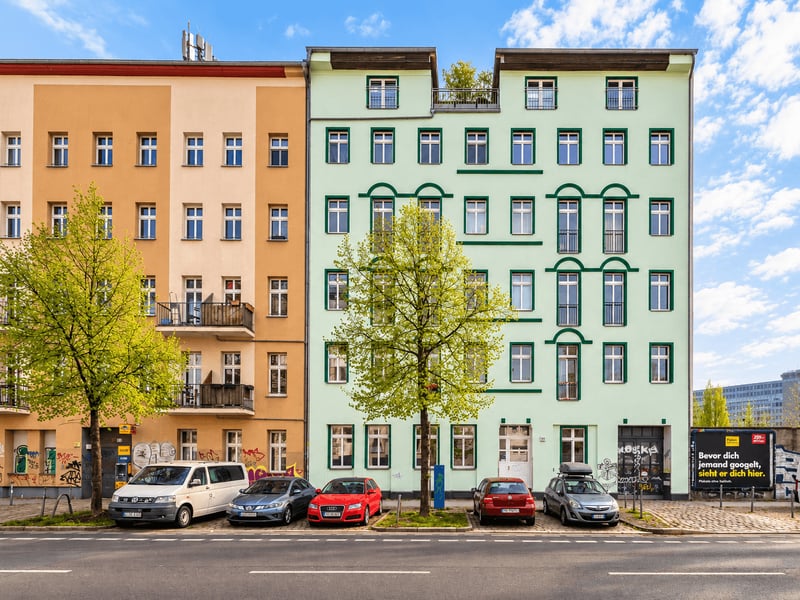
Almost 30 years after the fall of the Wall, Berlin remains a divided city in terms of urban planning. In the eastern part, areas without a local development plan follow Section 34 of the Building Code (BauGB): new buildings must fit into their surroundings. In the western part, the 1958 land use plan formally still applies. That plan reflected the ideal of a car-friendly, green, low-density city. The dense perimeter block development of the Gruenderzeit was considered outdated. The floor area ratio (GFZ) was capped at 1.5 even for heavily built-up inner-city areas, a figure barely compatible with the historical urban fabric.
Exemptions as a common workaround
The rigid 1.5 cap clashes with current market development and housing demand. Loft conversions or gap infills in block structures would be impossible under this limit. For years, borough offices have worked around it through "guidelines for approval practice," granting fee-based exemptions from the strict rules. Boroughs like Tempelhof-Schoeneberg or Neukoelln have set a GFZ of up to 3.75 as eligible for exemption. This practice alone shows that the planning goals of 1958 were abandoned long ago.
Court ruling: the land use plan is defunct
A ruling by the Berlin Administrative Court on March 17, 2017 has shaken things up. Two owners in Neukoelln had sued after their building permit for a loft conversion was denied. The borough argued that the resulting GFZ of over 4.4 far exceeded the 3.75 threshold it considered eligible for exemption.
The plaintiffs argued that the 1958 land use plan had become entirely "defunct" regarding the GFZ provision, meaning they did not need an exemption in the first place. The court agreed in the first instance. The judges found that the reality on the ground, where virtually no building meets the 1.5 GFZ limit, and the decades of exemption practice by boroughs prove the plan has lost its regulatory function.
Permits could move out of the exemption process
If confirmed in the next instance, this ruling would have consequences for developers and investors. Building applications would no longer need to go through the costly and often slow exemption process. Instead, the permissible scale of development would be governed directly by Section 34 BauGB: a project is permissible if it fits into the character of its immediate surroundings.
This could noticeably simplify permit procedures for creating new apartments in Berlin through infill development. It would end a legal uncertainty and place actual urban conditions above a plan that has been outdated for decades.
Disclaimer
This article is for general information only and does not constitute tax or legal advice. The content does not replace individual consultation with a tax advisor or attorney. No liability is assumed for accuracy or completeness.