

Character and identity
Steglitz lies in the southwest of Berlin and forms the namesake district of the Steglitz-Zehlendorf borough. Across roughly 6.8 square kilometres, the district sits between the denser quarters of Wilmersdorf and Friedenau to the north, Schöneberg to the east, and the villa and single-family-home areas of Lichterfelde and Dahlem to the south. Today 76,177 residents live here in 41,374 households, and the housing stock comprises 42,752 units.
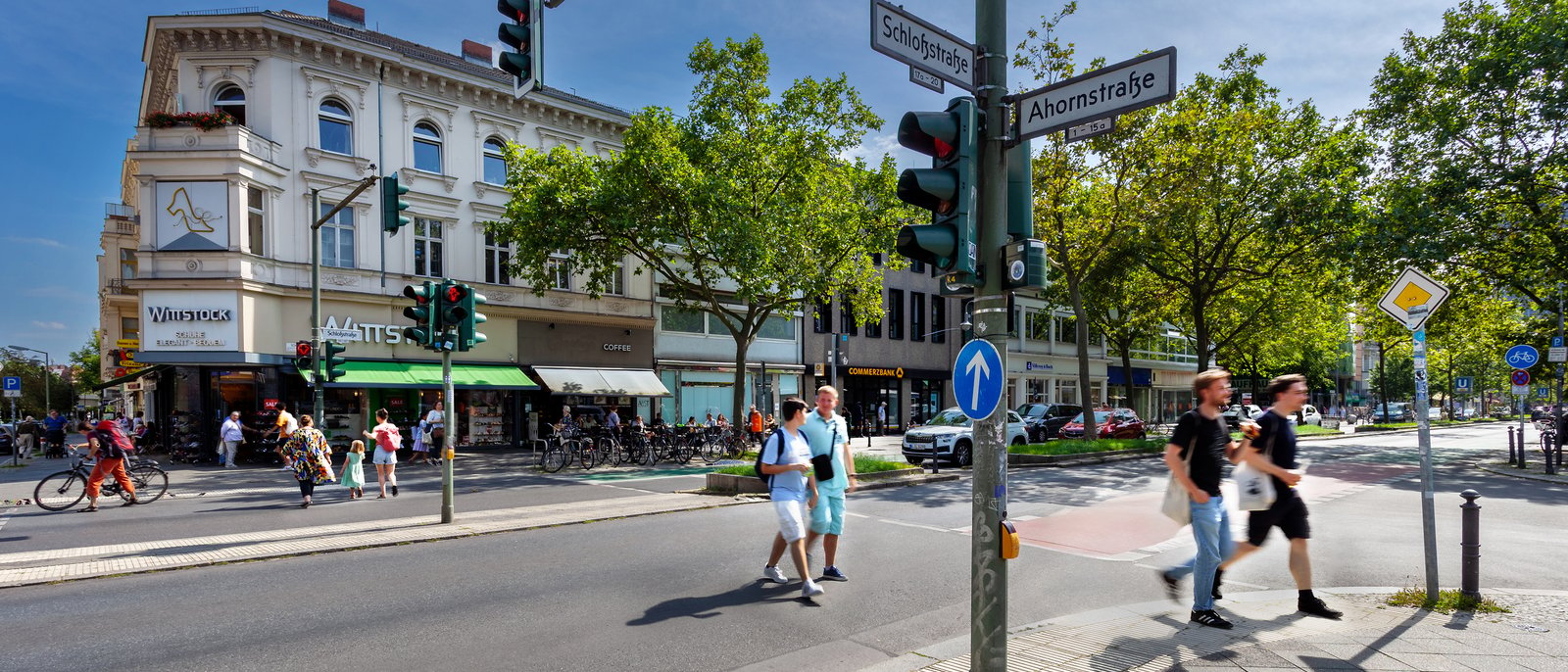
The backbone of the district is Schloßstraße. It ranks among Berlin's highest-grossing retail locations and gives Steglitz its urban pace. A few steps off it, things quickly grow quiet: narrow, green streets, 19th-century facades, front gardens. This dual nature shapes the place. Here a commercial location and a residential area meet in close quarters without pushing each other out.
For a long time Steglitz was seen as solidly bourgeois and a little staid. That image has shifted. The proximity to the Free University in Dahlem and to the Charité Campus Benjamin Franklin draws students, lecturers, and medical staff, and with them a younger, more international public. Steglitz has not become loud as a result, but it has become more mixed.
Anyone seeing the district for the first time recognises it by its silhouette. The Steglitzer Kreisel, a high-rise from the 1970s, and the Bierpinsel, a bright-red tower building above Schloßstraße, mark the centre even from a distance. Both date from a phase in which Steglitz wanted to reinvent itself as a modern borough centre. To this day they represent the break between Wilhelmine origins and post-war modernism that defines the district.
History and change
Steglitz is first mentioned in records in the 13th century and developed over the centuries as a village along the country road from Berlin to Potsdam. Today's Schloßstraße still partly follows this old route. It owes its name to the Wrangelschlösschen, a neoclassical country house from 1804 that has survived along the street.
With the building of the railway and the link to Berlin, the village grew rapidly in the 19th century. Around the turn of the century, Steglitz was considered one of the largest and wealthiest rural municipalities in Prussia. Much of today's pre-war building stock dates from this period, above all in the quarters around Grunewaldstraße and the Stadtpark.
This period also includes a cultural-historical footnote that reaches beyond Steglitz: around 1896 the Wandervogel movement began at the local grammar school, and from it the German youth movement of the 20th century emerged. For a few years Steglitz was thus a starting point of a reform-pedagogical current that shaped the country.
In 1920, as part of the formation of Greater Berlin, Steglitz became its own borough, together with the neighbouring towns of Lankwitz and Lichterfelde. The Second World War left clear marks. During reconstruction the priority was the rapid creation of housing rather than design ambition. That explains the high share of post-war buildings wedged between the surviving older buildings. In 2001 the Steglitz borough was merged with Zehlendorf to form today's Steglitz-Zehlendorf borough.
The most recent change concerns tenant protection. In February 2024 the first milieu protection areas came into force in Steglitz, among them the Feuerbachstraße, Gritznerstraße Nord, and Mittelstraße areas. This ended a long phase in which Steglitz was one of the few Berlin locations without social preservation statutes. For owners and investors, the rules of the game for conversion, modernisation, and conversion into residential ownership change as a result.
Sights
Most of the district's landmarks lie along Schloßstraße or nearby. The Titania-Palast, a cinema from the late 1920s, was one of the most important venues in West Berlin after the war and is still a cinema and performance venue today. A few hundred metres away stands the Rathaus Steglitz, the administrative seat and at the same time the district's central transport hub.
The Bierpinsel, officially a tower restaurant from the early 1970s, is probably the best-known structure. Its pop-art form above the Joachim-Tiburtius-Brücke divides opinion but is firmly part of the cityscape. Within sight rises the Steglitzer Kreisel, long an administrative high-rise, now converted into apartments.
Things are quieter at the Schwartzsche Villa, a 19th-century building on Grunewaldstraße that today serves as a borough cultural centre with a gallery and events. The neighbouring Wrangelschlösschen recalls the rural past. On Hermann-Ehlers-Platz stands the Spiegelwand, a memorial commemorating the Jewish residents deported from Steglitz.
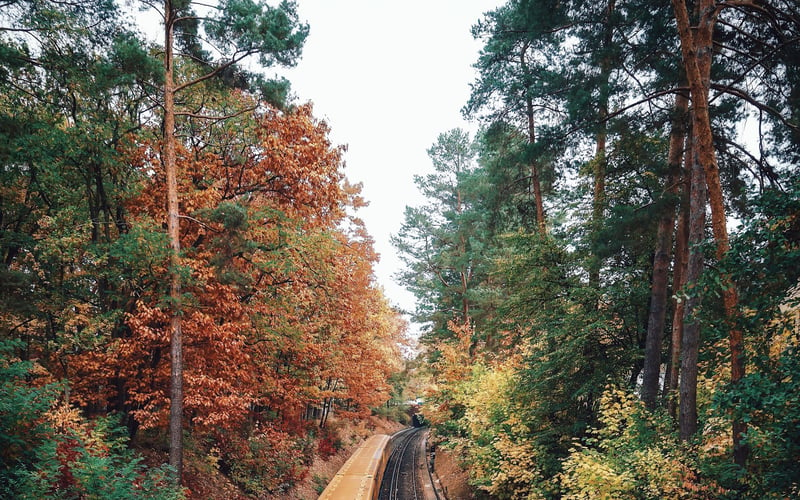
Those seeking greenery find it in the Stadtpark Steglitz with its old trees and in the Bäkepark, which follows the course of the former Bäke stream. The Fichtenberg, a wooded rise in the east of the district, is one of the few natural elevations in the flat southwest of Berlin.
Popular Kieze in Steglitz
- Around Schloßstraße: The commercial centre with department stores, shopping centres, and dense development. Here Steglitz is at its most urban, with a high share of smaller apartments and single-person households.
- Villa quarter around Paulsenstraße: Created east of the centre at the end of the 19th century as an elegant villa and country-house colony. Traffic-calmed, with terraced and single-family houses, popular with families.
- Quarters at the Stadtpark and on Grunewaldstraße: Continuous 19th-century development with well-preserved and renovated older buildings, some of them showpiece houses of the early Gründerzeit.
- Fichtenberg: Quiet residential location on the slope, away from the main axes, with a mixed stock of villas and upscale apartment buildings.
- South Steglitz along Steglitzer Damm and Albrechtstraße: Shaped by 1930s residential construction, often somewhat more affordable, with its own quarter character.
Scene and everyday life
Everyday life in Steglitz revolves to a good extent around Schloßstraße. With several shopping centres, department stores, and the continuous retail location, it covers almost every need and draws customers from across the southwest. Away from the large floor spaces, specialist shops and restaurants hold their own in the side streets.
A weekly market is regularly held on Hermann-Ehlers-Platz and is one of the district's fixed meeting points. Culturally, the Titania-Palast with concerts and events, and the Schwartzsche Villa with exhibitions and readings, set the tone. The Stadtpark Steglitz serves in summer as a green stage for open-air events and as a local recreation area.
The mix of commercial location, university proximity, and residential quarters means the district shows different faces at different times of day. By day the shopping and commuter public sets the scene; in the evening life shifts to the quieter quarters.
Who lives in Steglitz
The population of Steglitz is mixed but, compared with Berlin as a whole, rather older. Decades of established home ownership and stable tenancies have led to an age structure in which older cohorts are strongly represented. At the same time, the university and clinic locations ensure a steady influx of younger residents.
| Age group | Count | Share |
|---|---|---|
| under 6 | 3,575 | 5 % |
| 6–15 | 5,442 | 7 % |
| 15–18 | 1,779 | 2 % |
| 18–27 | 7,504 | 10 % |
| 27–45 | 21,077 | 28 % |
| 45–55 | 8,949 | 12 % |
| 55–65 | 10,841 | 14 % |
| 65+ | 17,010 | 22 % |
The household structure follows this pattern. Around Schloßstraße, smaller households and single-person apartments dominate the picture, while in the villa and terraced-house quarters larger households prevail. The following overview shows how household sizes are distributed across the district.
| Household size | Count | Share |
|---|---|---|
| 1 person | 24,549 | 59 % |
| 2 people | 9,606 | 23 % |
| 3 people | 3,658 | 9 % |
| 4 people | 2,437 | 6 % |
| 5 people | 681 | 2 % |
| 6+ people | 443 | 1 % |
This range is typical of Steglitz. Students in a one-room apartment near the university and established families in a terraced house a few streets away share the same district without inhabiting the same quarters.
The district's international character is closely linked to the academic and medical environment. The following breakdown shows the composition by region of origin.
| Region of origin | Count | Share |
|---|---|---|
| EU | 8,318 | 39 % |
| Turkey | 2,711 | 13 % |
| unassigned | 1,826 | 9 % |
| Ukraine | 1,650 | 8 % |
| Russia | 1,247 | 6 % |
| India | 833 | 4 % |
| Syria | 830 | 4 % |
| USA | 827 | 4 % |
| Iran | 786 | 4 % |
| China | 563 | 3 % |
| United Kingdom | 419 | 2 % |
| Lebanon | 391 | 2 % |
| Vietnam | 326 | 2 % |
| Afghanistan | 211 | <1 % |
| Kazakhstan | 176 | <1 % |
| Iraq | 169 | <1 % |
Who is drawn to Steglitz
The influx to Steglitz draws to a considerable extent on the educational and clinic institutions of the southwest. Those who study at the Free University or work at the Charité Campus Benjamin Franklin often look for housing a short distance away, which shapes the inflow.
| # | Country | Inflow | Outflow | Net |
|---|---|---|---|---|
| 1 | Indien | 227 | 73 | 154 |
| 2 | Ukraine | 181 | 132 | 49 |
| 3 | Türkei | 86 | 38 | 48 |
| 4 | Polen | 65 | 84 | -19 |
| 5 | China | 62 | 39 | 23 |
| 6 | Republik Korea | 55 | 31 | 24 |
| 7 | Italien | 53 | 63 | -10 |
| – | Deutschland | 1,175 | 1,603 | -428 |
Within Berlin, the exchange is close with the neighbouring districts of the southwest.
| # | District | People |
|---|---|---|
| 1 | Schöneberg | 359 |
| 2 | Lichterfelde | 303 |
| 3 | Wilmersdorf | 286 |
| 4 | Charlottenburg | 217 |
| 5 | Kreuzberg | 195 |
In the opposite direction, the movement runs similarly small-scale.
| # | District | People |
|---|---|---|
| 1 | Lichterfelde | 378 |
| 2 | Lankwitz | 243 |
| 3 | Schöneberg | 231 |
| 4 | Wilmersdorf | 230 |
| 5 | Zehlendorf | 183 |
Buildings and apartments
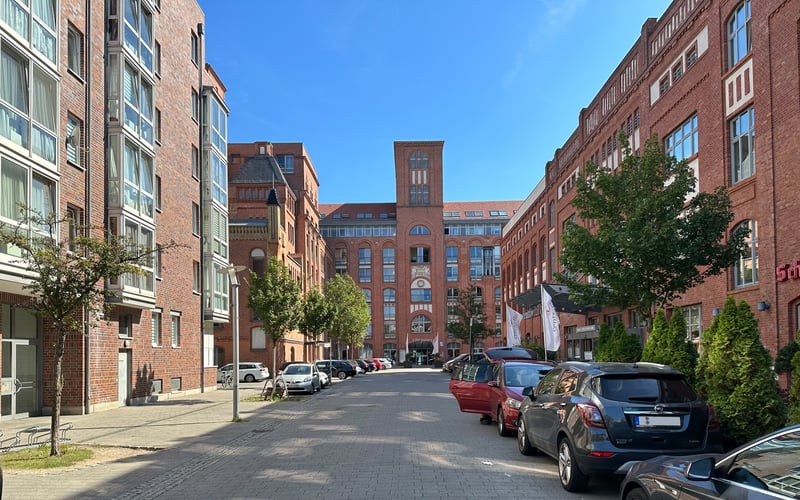
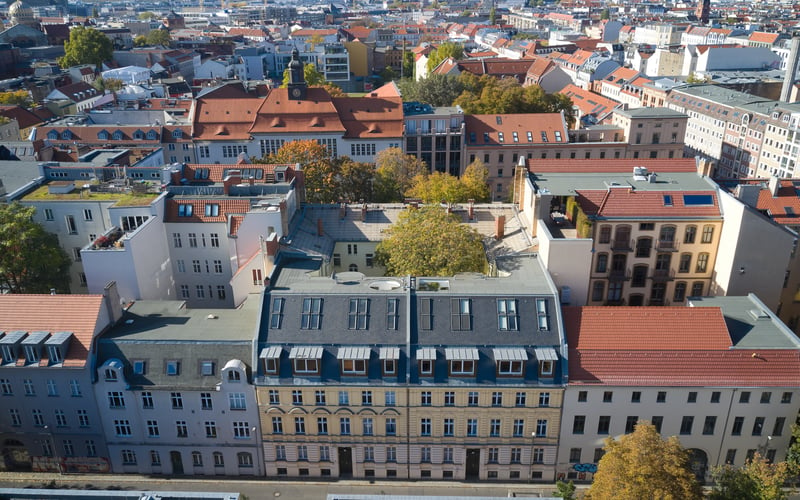
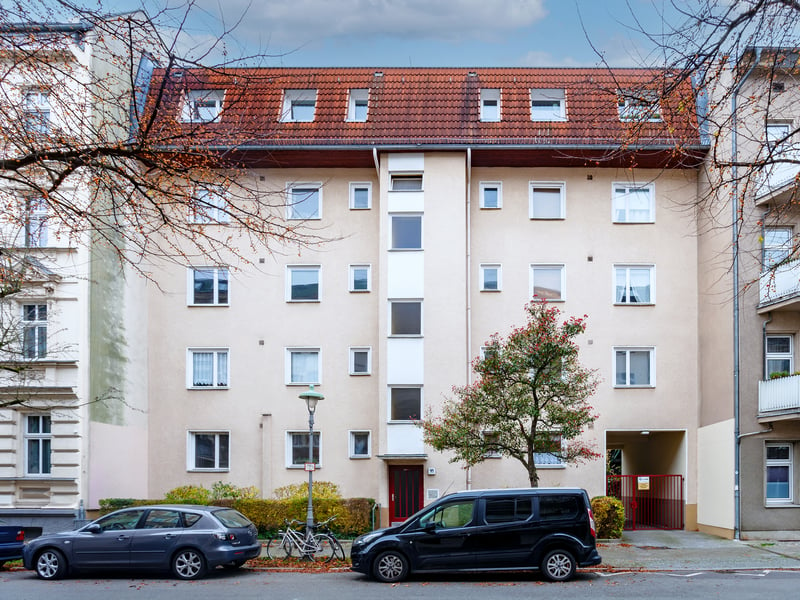
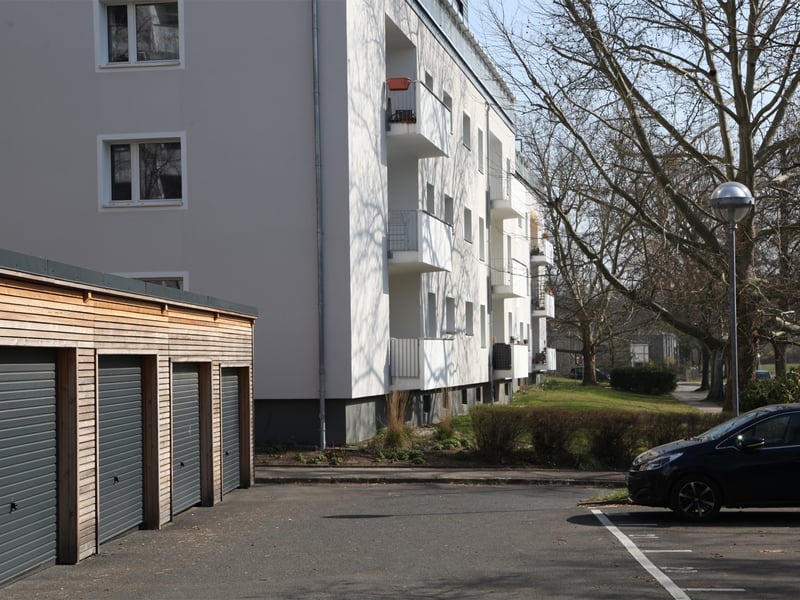
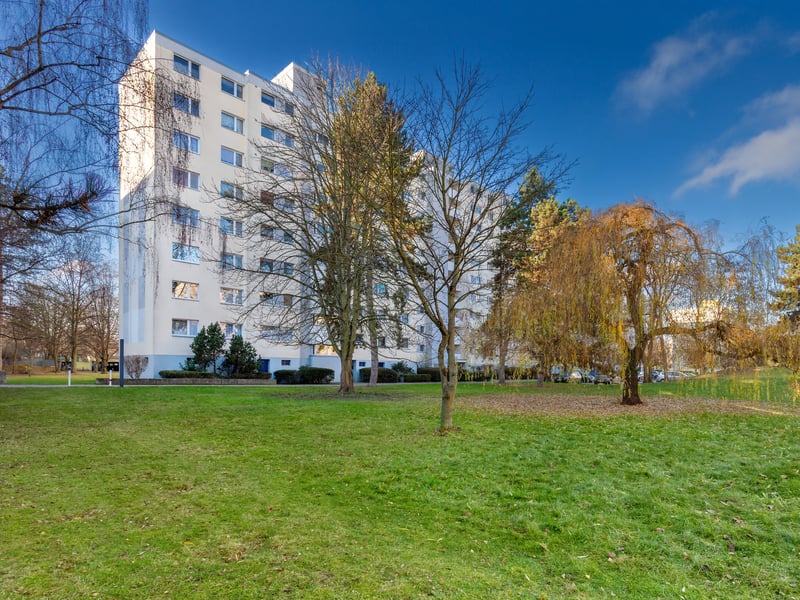
The building stock of Steglitz comprises 4,979 buildings and is structurally heterogeneous. Three layers can be distinguished: preserved 19th-century buildings from the growth phase before 1914, a large stock from the post-war reconstruction decades, and occasional new development. The post-war segment is particularly pronounced and shapes entire streets.
The housing stock stands at 42,752 units. Notable is the above-average average apartment size compared with Berlin as a whole, which goes back to the high share of generous older-building and terraced-house apartments. The following overview shows how the stock is distributed across the size classes.
| Size class | Count | Share |
|---|---|---|
| Unter 40 m² | 4,013 | 9 % |
| 40-59 m² | 11,989 | 28 % |
| 60-79 m² | 13,454 | 31 % |
| 80-99 m² | 6,729 | 16 % |
| 100-119 m² | 3,289 | 8 % |
| 120-139 m² | 1,675 | 4 % |
| 140-159 m² | 754 | 2 % |
| 160-179 m² | 360 | <1 % |
| 180-199 m² | 184 | <1 % |
| 200+ m² | 323 | <1 % |
The focus is on medium to large apartments; small units concentrate around Schloßstraße. The use of the stock is also informative about the district's social mix.
| Type of use | Count | Share |
|---|---|---|
| Rented | 35,476 | 81 % |
| Owner-occupied | 6,325 | 15 % |
| Vacant | 886 | 2 % |
| Commercial | 878 | 2 % |
Building activity is low. In the densely built district, new development changes the stock only slowly, and the housing balance remains low over the years.
| Period | Apartment balance |
|---|---|
| 2021 | 51 apartments |
| 2022 | 36 apartments |
| 2023 | 71 apartments |
| 2024 | 14 apartments |
With the milieu protection areas introduced in 2024, part of the stock is subject to additional requirements. In the affected quarters, certain modernisations, floor-plan changes, and conversions require approval. Anyone buying or holding here should know the location of their property relative to the protection areas.
Transport and infrastructure
Steglitz is closely connected to Berlin's local transport network. The Rathaus Steglitz underground station is the terminus of the U9 line, which runs directly to Zoologischer Garten and on to the north. In addition, the S1 suburban line stops there, connecting Steglitz with the city centre via the north-south tunnel, from Wannsee in the south to Oranienburg in the north. With the Schloßstraße underground station and the Botanischer Garten and Feuerbachstraße suburban stations, the district has several access points to the rail network.
For car traffic, the A103, the Steglitz city motorway, is important. It links the district to the city ring road and the supraregional network. The Südkreuz long-distance station can be reached in a few minutes and provides the connection to the ICE service.
In everyday life, several bus lines carry the load, among them metro buses connecting Schloßstraße with the surrounding districts. For cycling the topography is favourable; apart from the Fichtenberg, Steglitz is largely flat.
In terms of education, Steglitz benefits from its proximity to the Free University in Dahlem and from the Charité Campus Benjamin Franklin, one of the major clinic locations in the southwest of Berlin. At school level, the district enjoys a good reputation, with several grammar schools and primary schools close to homes.
Provision is densely covered via Schloßstraße with its shopping centres and the weekly market on Hermann-Ehlers-Platz. Medically, the district is well served by the Charité and resident practices.
Green spaces are distributed across the area. The Stadtpark Steglitz, the Bäkepark, and the wooded Fichtenberg lie within the district, and the Botanical Garden in neighbouring Lichterfelde is quickly reached. This combination of urban centre, quiet residential quarters, and local recreation within a short distance describes the district better than any single landmark.
Who Steglitz suits
- Students and clinic staff: FU Dahlem and Charité Benjamin Franklin nearby, small apartments around Schloßstraße, the U9 and S1 into the city centre. In sought-after locations the price level is above average.
- Families in the villa and terraced-house quarters: Quiet locations around Paulsenstraße and the Stadtpark with terraced and single-family houses, green spaces, and a good school reputation; larger properties are scarce and expensive.
- Value-oriented resale buyers: Structural variety from the 19th-century older building to the town villa; the 2024 milieu protection areas regulate conversion and modernisation.