

Character and identity
Neukölln sits southeast of central Berlin, framed by the Landwehrkanal and the Kreuzberg boundary to the north, the Tempelhofer Feld to the west and the Ringbahn to the south. The district forms the dense, urban core of the borough of the same name and covers around 11.7 km². It is home to 163,184 residents; the stock comprises 86,481 apartments and 83,947 households (source: Amt für Statistik Berlin-Brandenburg).
This portrait covers the district of Neukölln in the north of the borough. Britz, Buckow, Rudow and Gropiusstadt are separate districts with a more suburban character or one shaped by large housing estates, and they differ markedly from the period-building core described here.
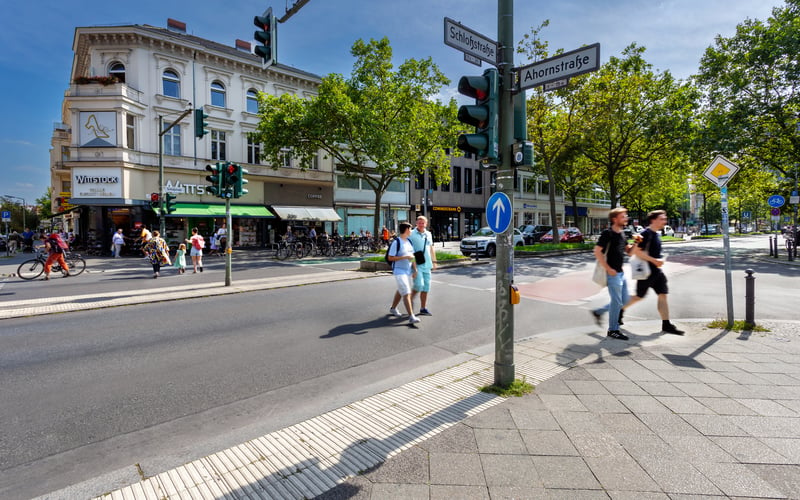
First-time visitors usually see Karl-Marx-Straße. The commercial spine, with the Neukölln town hall, the Neukölln Arcaden mall and a dense run of shops, late-night Spätis and snack bars, cuts straight through the district. A few hundred metres on, around Weserstraße and Reuterplatz, begins the quarter known internationally as Kreuzkölln, which runs seamlessly into Kreuzberg.
Few parts of Berlin are this international. Around Hermannplatz, Sonnenallee and the Maybachufer, communities from more than 160 nations live side by side. Sonnenallee is one of the city's central addresses of Arab life, while the Turkish Market on the Maybachufer keeps the tradition of Turkish immigration visible twice a week. This mix shapes daily life, from the food on offer to the look of the streets.
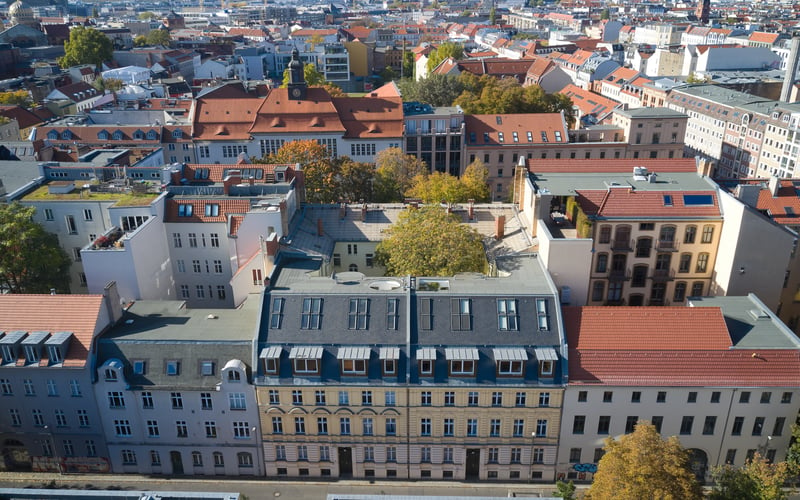
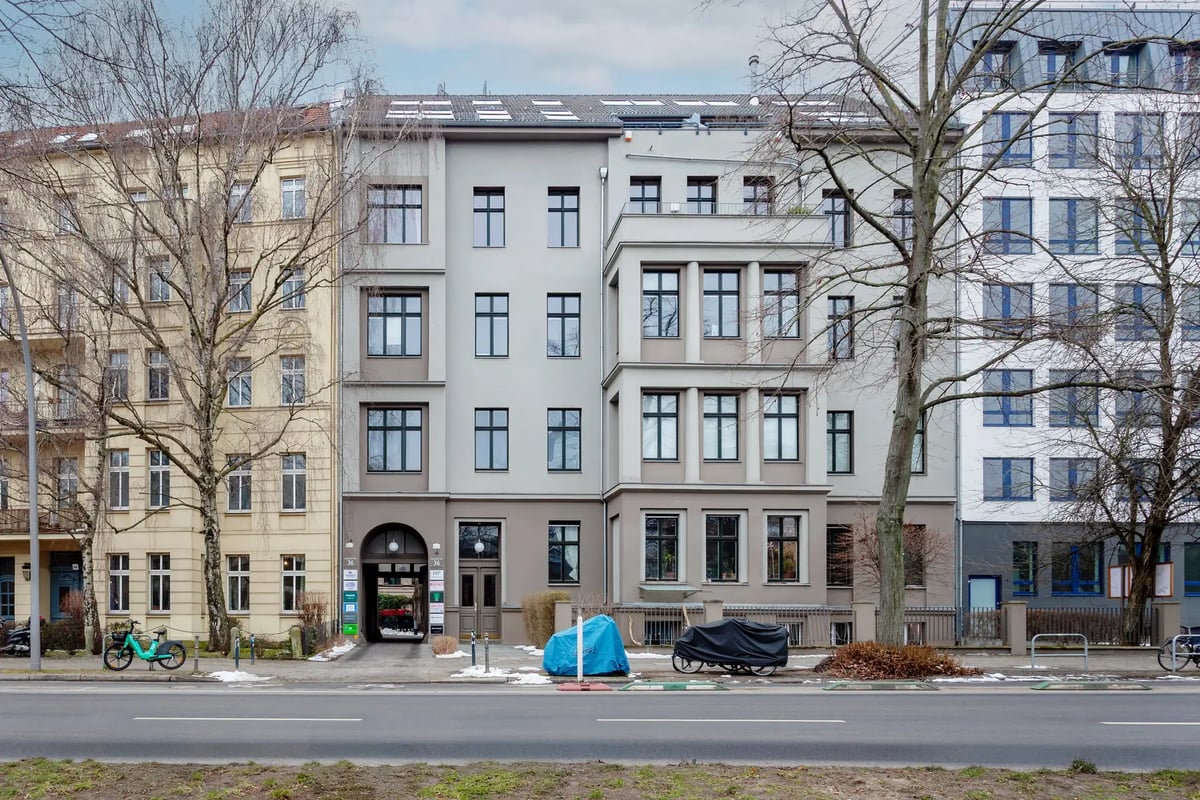
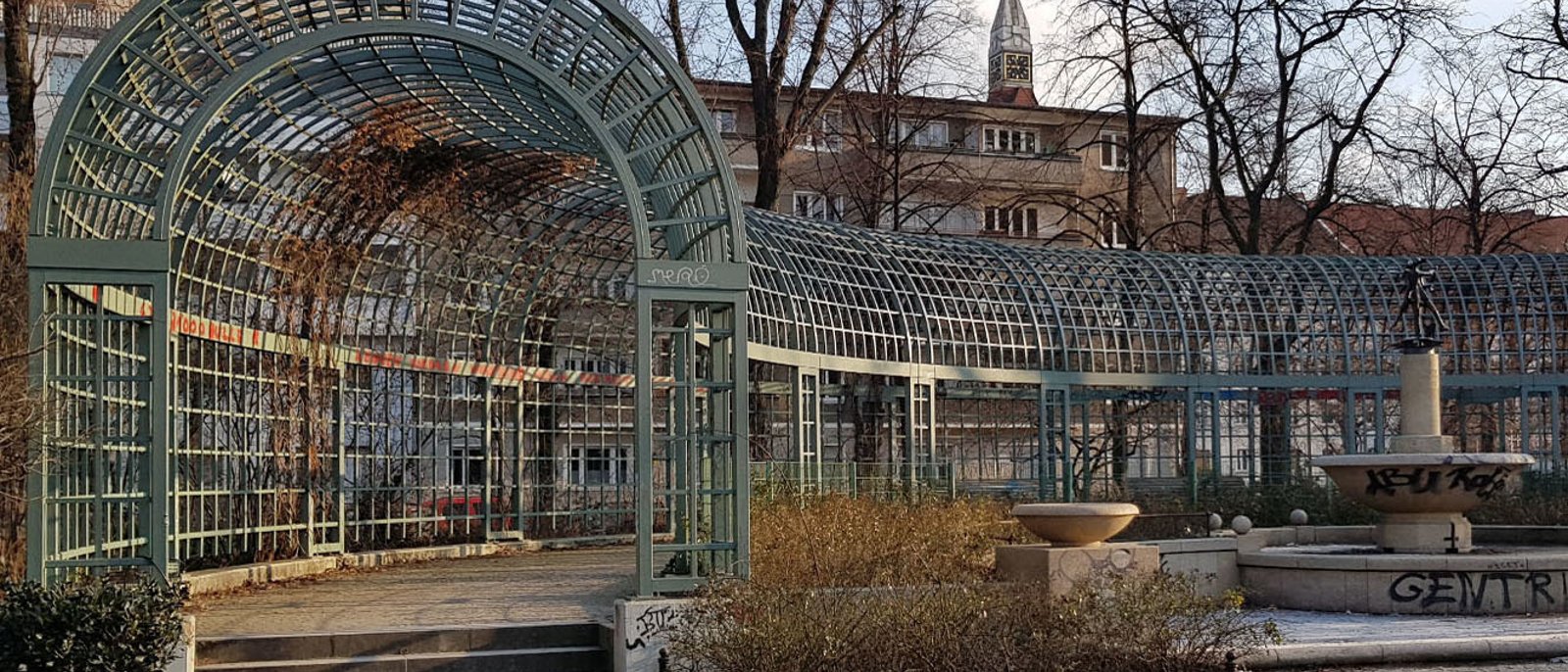
Architecturally the district is largely Gründerzeit. Closed perimeter blocks from around 1900 dominate, interspersed with housing from the 1920s and 1930s. In the core around Richardplatz, old Rixdorf, with its low houses and cobblestones, recalls the village past, while the quarters by the Tempelhofer Feld and the Körnerpark have quieter characters of their own.
History and change
Neukölln is older than its name. The settlement was first recorded in 1360 as Richardsdorp, founded in the orbit of the Order of St John. Richardsdorp became Rixdorf over the centuries, a village green around today's Richardplatz. In 1737 the Prussian king Friedrich Wilhelm I settled Bohemian religious refugees who had fled the Counter-Reformation as Protestant brethren. Alongside German Rixdorf a Bohemian village grew up, its traces still visible around the Comenius Garden and the working Rixdorf smithy.
In the 19th century Rixdorf grew quickly with industrialisation. It was granted town status in 1899 and soon ranked among the most densely built municipalities in Prussia. The place carried the reputation of an entertainment quarter; the song „In Rixdorf ist Musike“ stood for dance halls and a boisterous nightlife. To shed that image, the town applied in 1912 to be renamed Neukölln, after Cölln, Berlin's medieval sister city. In 1920 Neukölln became a borough when Greater Berlin was formed.
In the Weimar years the borough produced landmark reform housing estates, the best known of them in neighbouring Britz to the south. The northern district remained a densely built working-class quarter. From the 1960s, labour migrants, above all from Turkey, moved in and left a lasting mark on quarters such as Sonnenallee. For decades north Neukölln was known for low rents and social tension.
Since the mid-2000s the district has changed fast. Low rents and proximity to Kreuzberg drew students, creatives and international arrivals; around Reuterkiez, Kreuzkölln emerged as a new nightlife quarter. The borough responded to rising demand: in 2016 and 2017 the northern quarters were placed almost entirely under conservation-area protection (Milieuschutz, § 172 BauGB) to safeguard the make-up of the resident population.
Sights
The best-known historic address is Rixdorf around Richardplatz. The Bohemian village, with the Bethlehem congregation, the Comenius Garden and the still-working Rixdorf smithy, forms a village core in the middle of the city. In December the Rixdorf Christmas market, with its historic layout, draws visitors from across Berlin.
The Körnerpark is the district's green surprise. Laid out between 1912 and 1916 in a former gravel pit in the style of a Baroque palace garden, it has an orangery, the Galerie im Körnerpark and a café. The larger recreation area is the Hasenheide, a public park where Friedrich Ludwig Jahn opened the first German gymnastics ground in 1811. Today it holds an open-air cinema, a small animal enclosure and broad meadows.
The Tempelhofer Feld borders the district to the west, the former airfield of Tempelhof Airport, open to the public since 2010 as one of the largest inner-city open spaces in Europe. On Sonnenallee stands the Estrel, Germany's largest hotel and convention centre. Cultural life is anchored by the Heimathafen Neukölln on Karl-Marx-Straße, the cinema in the Passage and the listed Stadtbad Neukölln from the 1910s. Once a year the city-wide festival 48 Stunden Neukölln fills courtyards, shops and studios across the district.
Popular Kieze in Neukölln
- Reuterkiez (Kreuzkölln): Between the Landwehrkanal, Kottbusser Damm and Sonnenallee, the heart of the young, international scene. Dense bar and café life along Weserstraße, a high share of period buildings, strong demand.
- Schillerkiez: West of Hermannstraße, right by the Tempelhofer Feld. The Schillerpromenade with the Genezareth church on Herrfurthplatz forms its backbone; the location by the field keeps demand high.
- Rixdorf (Richardkiez): The historic village core around Richardplatz, quiet, low-rise, with Bohemian history and cobblestones.
- Körnerkiez: Around the Körnerpark between Karl-Marx-Straße and the Ringbahn, defined by period buildings and the calm setting by the park.
- Rollbergkiez: The Rollberg estate south of Karl-Marx-Straße, a quarter rebuilt in the 1970s with a social profile of its own.
Scene and everyday life
The district's culinary centre of gravity is in the north. Bars, Spätis and small restaurants line Weserstraße; Sonnenallee provides food shops, bakeries and eateries of the Arab community around the clock. The Turkish Market on the Maybachufer is a fixed meeting point for vegetables, fabrics and street food on Tuesdays and Fridays.
On top of the Neukölln Arcaden, the Klunkerkranich rooftop garden has become one of the best-known viewpoints and event spaces in the district. Cultural anchors are the Heimathafen Neukölln, the Galerie im Körnerpark and the Stadtbad Neukölln. In summer the open-air cinema runs in the Hasenheide; in early summer 48 Stunden Neukölln opens studios and courtyards to a broad audience. The everyday between these events is less glamorous and more about local supply, weekly markets and neighbourhood initiatives than the image suggests.
Who lives in Neukölln
Neukölln is defined by small households and a young, international population. The breakdown below shows how households are distributed by size.
The age structure is shaped by younger working-age residents, with a high share of people in their twenties and thirties. That reflects the character of an entry-point and scene quarter.
The international character of the district shows in the composition of the resident population by region of origin.
In few other districts is the share of residents with roots in Turkey, the Arab states and southeastern Europe as high. This diversity is not a side note; it has defined the quarter for decades and sets Neukölln apart from most other Berlin locations.
Who is drawn to Neukölln
How the population renews itself shows in the migration data. Neukölln grows mainly through arrivals from outside Berlin, while it loses residents on balance in its exchange with the outskirts and the southern districts.
| # | Country | Inflow | Outflow | Net |
|---|---|---|---|---|
| 1 | Indien | 647 | 166 | 481 |
| 2 | Türkei | 458 | 316 | 142 |
| 3 | Rumänien | 298 | 362 | -64 |
| 4 | Bulgarien | 263 | 355 | -92 |
| 5 | Italien | 261 | 316 | -55 |
| 6 | Arabische Republik Syrien | 241 | 107 | 134 |
| 7 | Ukraine | 229 | 173 | 56 |
| – | Deutschland | 2,762 | 3,139 | -377 |
Across the city boundary, international arrivals carry the growth, with recurring strong source countries in southeastern Europe and Turkey.
| # | District | People |
|---|---|---|
| 1 | Kreuzberg | 1,184 |
| 2 | Friedrichshain | 731 |
| 3 | Prenzlauer Berg | 490 |
| 4 | Schöneberg | 444 |
| 5 | Tempelhof | 359 |
Within Berlin the exchange is closest with directly adjacent Kreuzberg and the surrounding districts.
| # | District | People |
|---|---|---|
| 1 | Kreuzberg | 1,137 |
| 2 | Friedrichshain | 681 |
| 3 | Prenzlauer Berg | 520 |
| 4 | Schöneberg | 445 |
| 5 | Britz | 377 |
In the other direction the movement runs on a small scale into the southern Neukölln districts of Britz and Buckow and into the Brandenburg outskirts. This suburbanisation has continued for years and reflects the tighter housing market in the dense north.
Buildings and apartments
The building stock comprises 6,610 buildings. At its core is Gründerzeit period stock from around 1900, complemented by housing from the 1920s and 1930s and individual post-war buildings such as the Rollberg estate. There are no large-scale prefabricated estates in the district; those define another part of the borough, in Gropiusstadt. No chart data source for construction periods is available; this assessment draws on the Guthmann market report.
The high share of small households is mirrored in the housing stock. The breakdown below shows how apartments are distributed across size classes.
The use of the stock, that is the ratio of rented to owner-occupied apartments, also helps place the district.
At its core Neukölln is a rental quarter. The share of owner-occupied housing is markedly lower than in the southern districts of the borough, where single-family homes and garden-city estates set the tone. In the densely built north, new construction comes mainly through infill, adding storeys and individual projects on former commercial sites, for instance along Saalestraße.
Transport and infrastructure
Neukölln is closely tied into the rapid-transit network. The U7 runs beneath Karl-Marx-Straße with the stations Hermannplatz, Rathaus Neukölln, Karl-Marx-Straße and Neukölln, linking the district to Kreuzberg and the west of the city. The U8 runs via Schönleinstraße, Hermannplatz, Boddinstraße, Leinestraße and Hermannstraße towards Wedding. The two lines meet at Hermannplatz.
The Ringbahn (S41 and S42) frames the district to the south, with the stations Neukölln, Hermannstraße and Sonnenallee. Neukölln station and Hermannstraße thus become important interchanges between U-Bahn and S-Bahn, taking the district both into the centre and onto the ring.
The towpath along the Landwehrkanal forms a quiet north-south route for cyclists, and the Tempelhofer Feld offers wide, car-free paths to the west. Several residential streets in Reuterkiez and Schillerkiez are traffic-calmed, though the high building density and pressure on parking remain noticeable in daily life.
Retail concentrates on Karl-Marx-Straße with the Neukölln Arcaden and a dense run of owner-run shops along Sonnenallee and Hermannstraße. Schools and day-care centres are spread across the residential quarters; the adult education centre and the public library near the town hall are the district's central educational institutions.
With the Hasenheide, the Körnerpark and the adjacent Tempelhofer Feld, the densely built district has three very different green spaces. The Landwehrkanal adds a waterfront in the north that ranks among the most heavily used public spaces in the quarter in summer.
Who Neukölln suits
- International newcomers: The high share of small apartments, the pronounced rental market and strong arrivals from outside make Kreuzkölln and Reuterkiez classic entry points for young immigrants and students. Price levels have risen, and supply is mostly rental.
- Creative and hospitality scene: The dense fabric of bars, studios and venues along Weserstraße and around the Klunkerkranich draws people from culture and hospitality who want short distances and urban density.
- Families on the green edges: Schillerkiez by the Tempelhofer Feld and Körnerkiez by the park offer period flats in calmer settings with quick access to green space, sought after by families who want to stay in the inner city.
- Buy-to-let investors in period stock: The Gründerzeit stock, with sensible unit sizes and steady lettability, appeals to investors. The blanket Milieuschutz in the north, however, regulates conversion and modernisation and belongs in every calculation.