

Character and identity
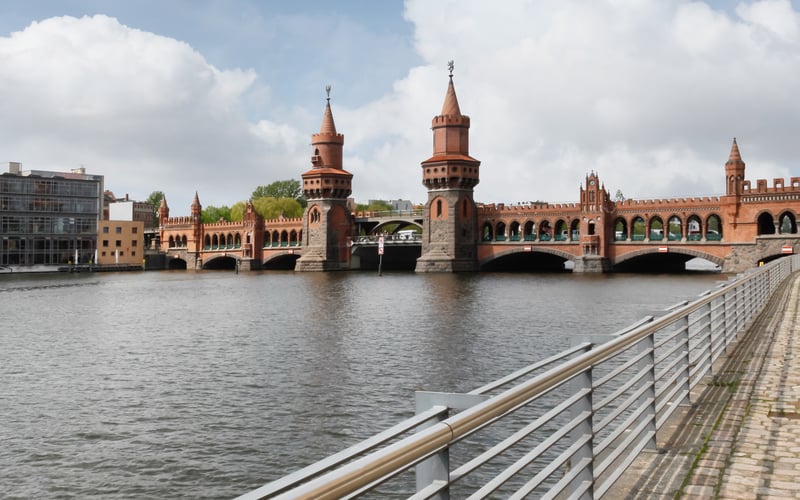
Friedrichshain is the densely built inner-city district in the east of Berlin and the name-giving part of the borough of Friedrichshain-Kreuzberg, to which it has been connected across the Spree by the Oberbaumbrücke since the borough merger in 2001. The district lies at 52.51 N and 13.45 E across roughly 9.9 km2. 142,116 residents live within this area; 78,223 apartments are spread across 76,353 households (source: Amt für Statistik Berlin-Brandenburg).
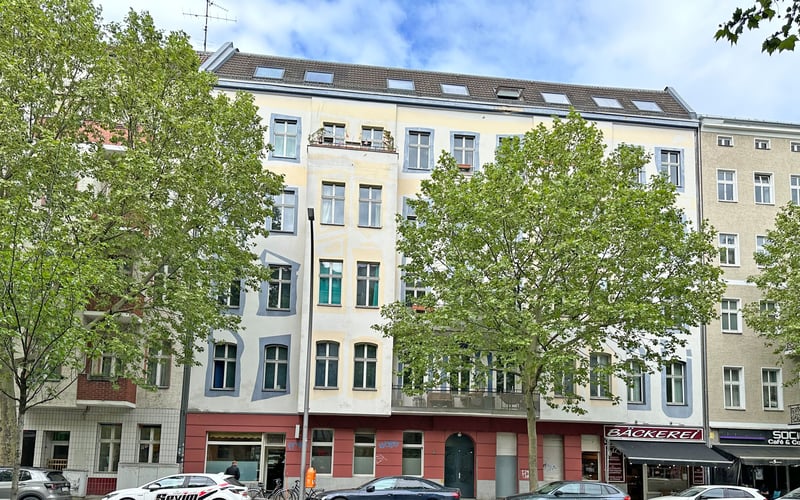
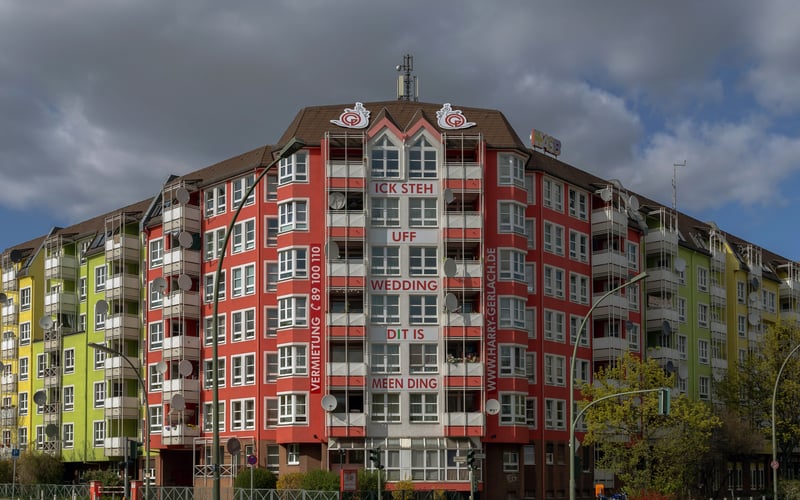
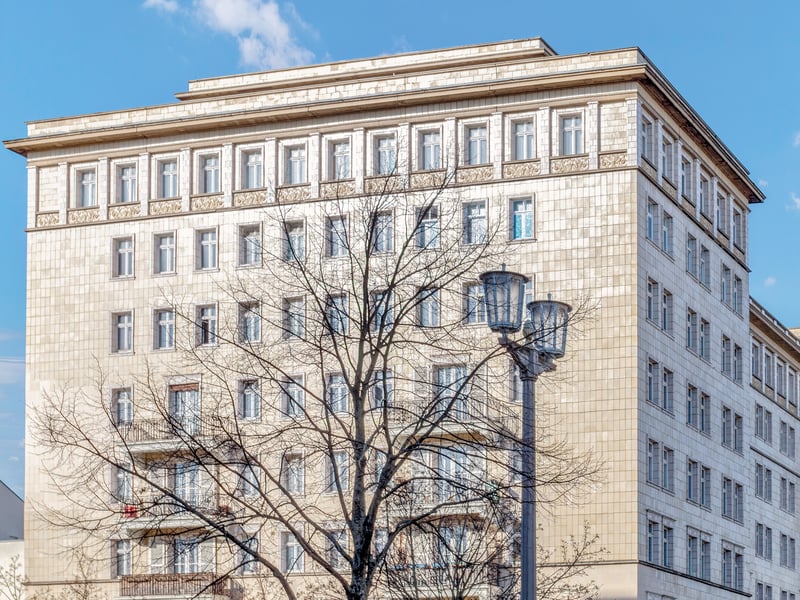
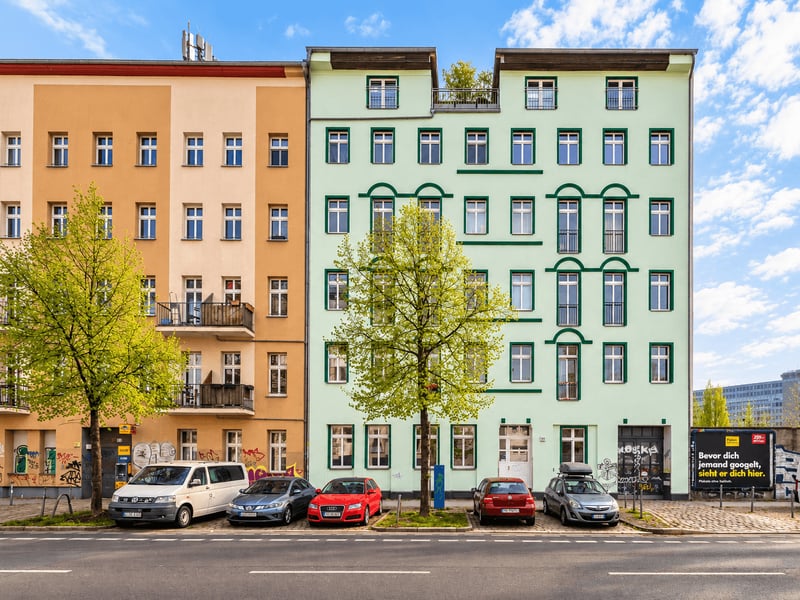
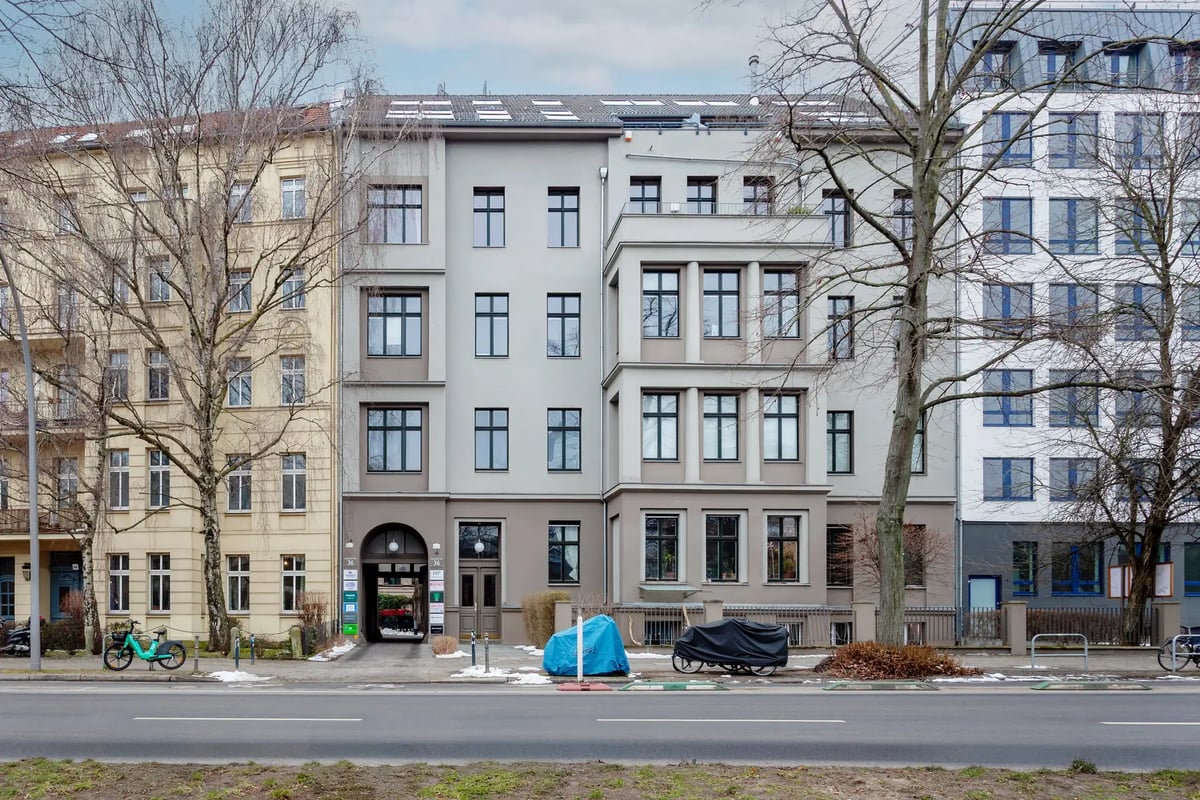
Friedrichshain is among the most densely populated quarters in Germany, and it is so across three clearly distinguishable architectural layers. In the east, closed Gründerzeit blocks from around 1900 shape the streetscape. Along Karl-Marx-Allee and Frankfurter Allee stand the residential rows of GDR modernism. On the banks of the Spree, old warehouses, cold stores and harbour facilities have become the office and residential quarters of Mediaspree. The imperial era, socialist urban planning and the glass facades of the 2010s sit side by side here within a few square kilometres.
The district grew up as a working-class quarter and still carries that origin in its structure today. The perimeter block development with front and rear buildings, the proximity of housing and former industry on the water, and the small-scale mix of trades, commerce and housing characterise large parts of the quarter. After 1990, a second defining trait was added: Friedrichshain became one of the most important places for Berlin's club culture and electronic music, with the RAW-Gelände on Revaler Straße and the Berghain at the Wriezener Bahnhof as its best-known addresses.
The East Side Gallery on the bank of the Spree, a 1.3-kilometre painted section of the former Berlin Wall, keeps the history of division visible. A few hundred metres further on, the Uber Arena (formerly Mercedes-Benz Arena) and the adjoining Uber Platz draw concert and event audiences. With Boxhagener Platz, the Volkspark Friedrichshain and the Frankfurter Tor, the district also has quiet, residential centres. This range between the night-time economy and everyday Kiez life defines the picture of Friedrichshain.
History and change
Friedrichshain owes its name to the Volkspark Friedrichshain, laid out from 1846 on what was then the north-eastern edge of the city to mark the hundredth anniversary of Friedrich II's accession to the throne. With industrialisation, a dense working-class quarter grew up around the park. Warehouses, slaughterhouses and the Osthafen rose along the Spree, and the typical Gründerzeit tenements appeared in the side streets. Until the turn of the century, the area, then still part of the Stralauer Viertel and later run as its own administrative borough, was one of the most densely populated industrial quarters in Berlin.
The Second World War hit Friedrichshain hard. Large parts of the residential development were destroyed, and the Volkspark Friedrichshain was reshaped by two demolished flak towers and piled-up war rubble, whose remains lie in the park today as green hills, known colloquially as Mont Klamott. After 1949, the district lay in East Berlin and became a showcase of socialist urban planning. From 1952, the destroyed Frankfurter Allee became the Stalinallee, a wide boulevard with grand residential palaces in the style of the national tradition, designed among others by Hermann Henselmann. The twin towers at the Frankfurter Tor and the streetscape at Strausberger Platz date from this period.
On the Stalinallee, the construction workers' uprising against raised work quotas began on 17 June 1953 and quickly grew into a nationwide popular uprising in the GDR. After de-Stalinisation, the boulevard was renamed Karl-Marx-Allee in 1961, and the western section with Kino International, Café Moskau and the residential slabs followed a more sober modernism. With the building of the Wall in 1961, the bank of the Spree moved to the sector border. The strip of wall along Mühlenstraße, where the East Side Gallery stands today, remained a border installation until 1989.
After the fall of the Wall, a far-reaching transformation set in. A first wave of modernisation and new construction around the turn of the millennium, often with funding from the Investitionsbank Berlin, renovated the partly badly neglected Gründerzeit stock and laid the ground for the later development of the residential quarters east of Warschauer Straße and north of Frankfurter Allee. From the 2000s, the Mediaspree development area grew along the Spree with media, music and technology companies. In 2001, as part of the Berlin administrative reform, Friedrichshain was merged with Kreuzberg into the joint borough of Friedrichshain-Kreuzberg. To protect the existing stock from displacement, several conservation areas under section 172 of the Building Code are now designated in Friedrichshain.
Sights
The district's best-known address is the East Side Gallery. On the longest preserved stretch of the Berlin Wall, artists captured the period of the political turnaround in murals in 1990, among them the often-cited Fraternal Kiss motif. At the southern end of the gallery, the Oberbaumbrücke spans the Spree, a brick structure from 1896 with an elevated railway viaduct that connects Friedrichshain with Kreuzberg and has become the landmark of the merged borough.
The Karl-Marx-Allee is a monument in its own right as an urban planning ensemble. The Frankfurter Tor with the domed towers designed by Henselmann, the monumental residential rows and the Kino International count as central examples of GDR architecture. In the surroundings of the former Mokka-Milch-Eisbar and along the avenue, Café Sibylle and the Computerspielemuseum recall the everyday life and the culture of remembrance of the boulevard.
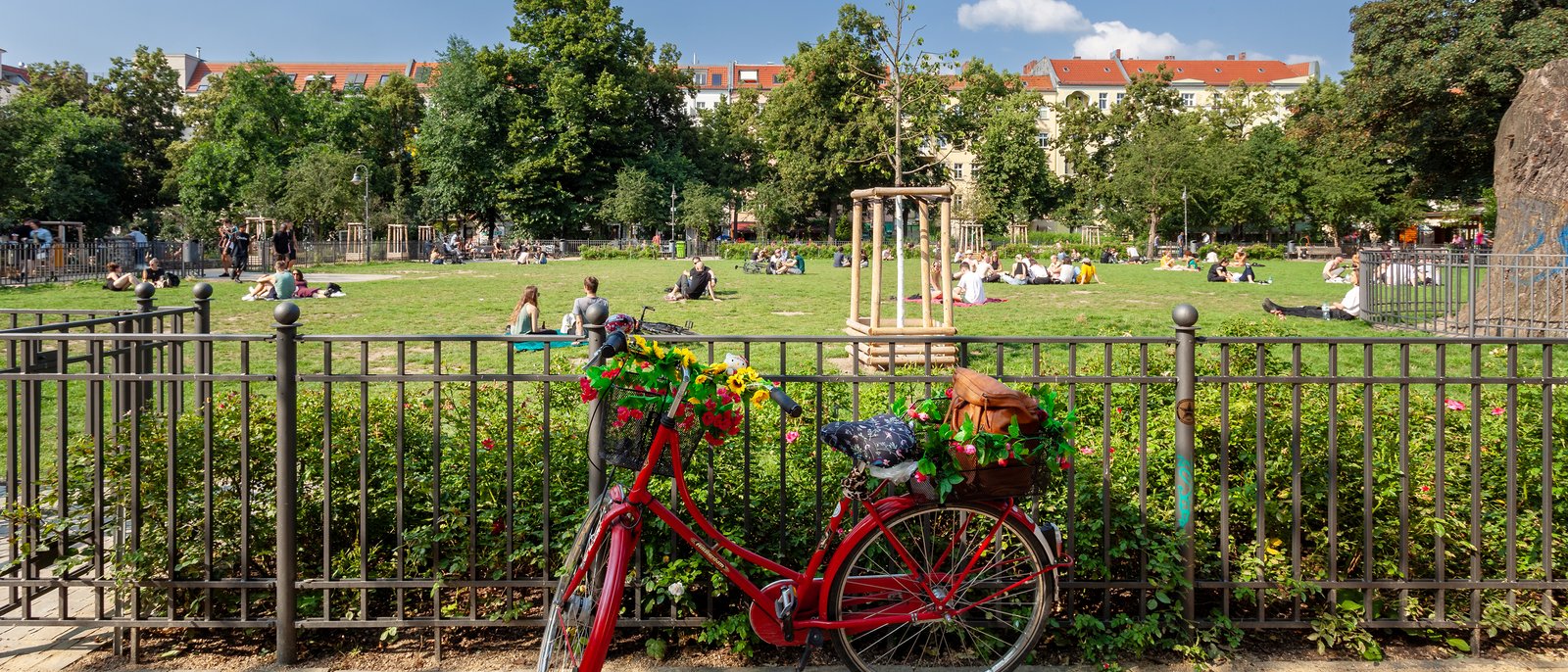
The Volkspark Friedrichshain is the oldest municipal park in Berlin. Alongside the green rubble hills lie the Märchenbrunnen from 1913, expansive lawns, an open-air cinema and sports facilities. In the south of the district, the Stralau peninsula with the Dorfkirche Alt-Stralau forms a quiet counterpoint on the water, where village remnants, commercial buildings and new residential quarters meet. Along the Spree, the brick warehouses of the Osthafen, which today house a record label and media firms among others, shape the bank.
Popular Kieze in Friedrichshain
- Boxhagener Kiez: The quarter around Boxhagener Platz, called Boxi by residents, is the best-known residential Kiez in the east of the district. Gründerzeit blocks, a weekly market on Saturdays and a flea market on Sundays, plus a high density of cafés and small shops shape the picture.
- Simon-Dach-Kiez: Immediately west of Boxhagener Platz, around Simon-Dach-Straße, the going-out gastronomy with bars, restaurants and pubs is concentrated. In the evening, the Kiez draws a supraregional and international crowd.
- Samariterkiez: Around the Samariterkirche and Bänsch- and Samariterstraße lies a quieter Gründerzeit quarter heavily inhabited by families, with a dense tree population and local supply within the block.
- Traveplatzkiez: The Trave quarter in the north counts among the sought-after, residential locations. Traveplatz with its green space forms the centre of a largely closed period-building stock.
- Stralau peninsula: On the narrow spit of land between the Spree and the Rummelsburger Bucht, new waterside residential quarters have arisen over the past two decades, complemented by the historic remnants of the old fishing village of Stralau.
- Weberwiese and Karl-Marx-Allee: The quarters north and south of the boulevard combine the listed GDR buildings with quiet residential streets and the green space at the Weberwiese.
Scene and everyday life
Friedrichshain is one of the centres of Berlin nightlife. The RAW-Gelände on Revaler Straße, a former railway repair works, houses clubs, concert venues, a skate park and event spaces. The Berghain at the Wriezener Bahnhof is regarded internationally as one of the most important addresses of electronic music. Further clubs and beach bars line the Spree, and at the Holzmarkt near the Jannowitzbrücke a cultural and gastronomy quarter has grown up on a former industrial site.
Everyday life plays out in the Kieze. Boxhagener Platz supplies the quarter with a weekly and flea market, Simon-Dach-Straße and Wühlischstraße bundle the gastronomy, and an antiques and book market takes place regularly at the Ostbahnhof. The Modersohnbrücke over the railway tracks is a well-known meeting point at sunset. With the Uber Arena, the adjoining Uber Eats Music Hall and the Uber Platz, the district also has one of the largest event venues in the city. Cultural and sports offerings, galleries and art-house cinemas such as the Kino International round out the picture.
Who lives in Friedrichshain
Friedrichshain is demographically the youngest district in Berlin and strongly shaped by small households. Single-person households and shared flats define the social structure, which can be read from the distribution of household sizes.
| Household size | Count | Share |
|---|---|---|
| 1 person | 49,448 | 65 % |
| 2 people | 15,392 | 20 % |
| 3 people | 6,333 | 8 % |
| 4 people | 3,529 | 5 % |
| 5 people | 886 | 1 % |
| 6+ people | 765 | 1 % |
The age structure is clearly marked by young adults and career starters. Families with children concentrate in the quieter Kieze such as the Samariter- and the Traveplatzkiez, while the quarters around the going-out strips stay younger and more fluctuating.
| Age group | Count | Share |
|---|---|---|
| under 6 | 7,254 | 5 % |
| 6–15 | 10,140 | 7 % |
| 15–18 | 2,800 | 2 % |
| 18–27 | 14,494 | 10 % |
| 27–45 | 61,871 | 44 % |
| 45–55 | 19,407 | 14 % |
| 55–65 | 12,940 | 9 % |
| 65+ | 13,210 | 9 % |
The district is markedly international. Friedrichshain is especially popular as a place to live among newcomers from western and southern Europe as well as from North America, which the composition of the resident population by region of origin shows.
| Region of origin | Count | Share |
|---|---|---|
| EU | 20,034 | 43 % |
| Vietnam | 3,683 | 8 % |
| Turkey | 2,947 | 6 % |
| Russia | 2,920 | 6 % |
| India | 2,759 | 6 % |
| Ukraine | 2,583 | 6 % |
| Syria | 2,420 | 5 % |
| USA | 2,351 | 5 % |
| United Kingdom | 1,844 | 4 % |
| unassigned | 1,747 | 4 % |
| Iran | 720 | 2 % |
| China | 634 | 1 % |
| Kazakhstan | 529 | 1 % |
| Afghanistan | 516 | 1 % |
| Iraq | 411 | <1 % |
| Lebanon | 334 | <1 % |
Who is drawn to Friedrichshain
The migration data show how the population renews itself. Friedrichshain grows through inflow from abroad, while the district gives up residents on balance in its exchange with the Berlin surrounding area and with other boroughs. International inflow has carried the growth for years.
| # | Country | Inflow | Outflow | Net |
|---|---|---|---|---|
| 1 | Indien | 598 | 226 | 372 |
| 2 | Italien | 365 | 354 | 11 |
| 3 | Türkei | 310 | 169 | 141 |
| 4 | Vietnam | 266 | 122 | 144 |
| 5 | Russische Föderation | 259 | 103 | 156 |
| 6 | Ukraine | 257 | 169 | 88 |
| 7 | Vereinigte Staaten | 201 | 158 | 43 |
| – | Deutschland | 2,918 | 3,733 | -815 |
Within Berlin, the exchange runs on a small scale, above all with the adjoining districts in the east and in the inner city.
| # | District | People |
|---|---|---|
| 1 | Prenzlauer Berg | 959 |
| 2 | Kreuzberg | 738 |
| 3 | Neukölln | 681 |
| 4 | Mitte | 648 |
| 5 | Wittenau | 559 |
In the opposite direction, a similar pattern appears: those who leave Friedrichshain often stay nearby or move to the quarters adjoining to the east and north.
| # | District | People |
|---|---|---|
| 1 | Prenzlauer Berg | 995 |
| 2 | Neukölln | 731 |
| 3 | Kreuzberg | 678 |
| 4 | Mitte | 618 |
| 5 | Rummelsburg | 353 |
Buildings and apartments
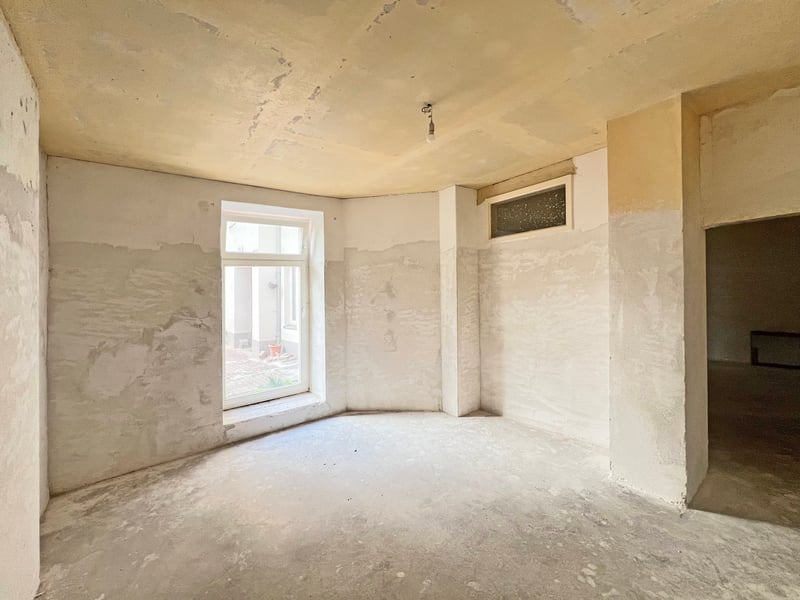
The building stock comprises 4,967 buildings. The core of the housing stock is the Gründerzeit period building, with a focus on the construction period between 1900 and 1920. To this are added the residential buildings of GDR modernism along Karl-Marx- and Frankfurter Allee as well as the new developments of the past two decades, above all in the Spree quarters and on the Stralau peninsula. The construction period of the 1950s to 1970s plays a subordinate role in the stock. A dedicated chart data source for the construction periods is not available; this classification rests on the Guthmann market report.
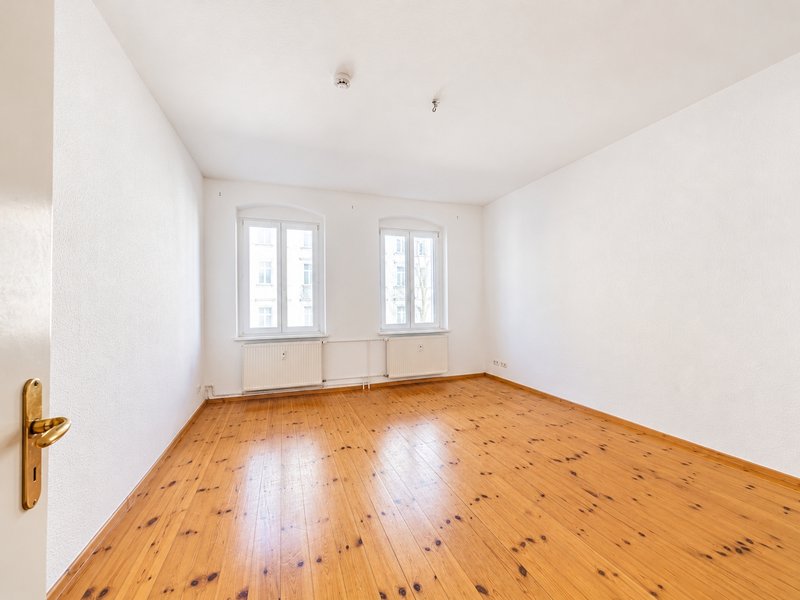
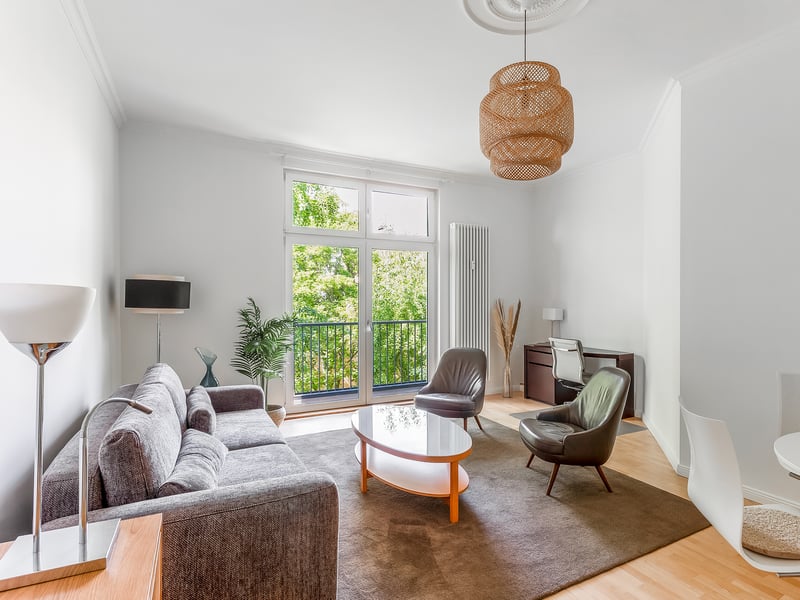
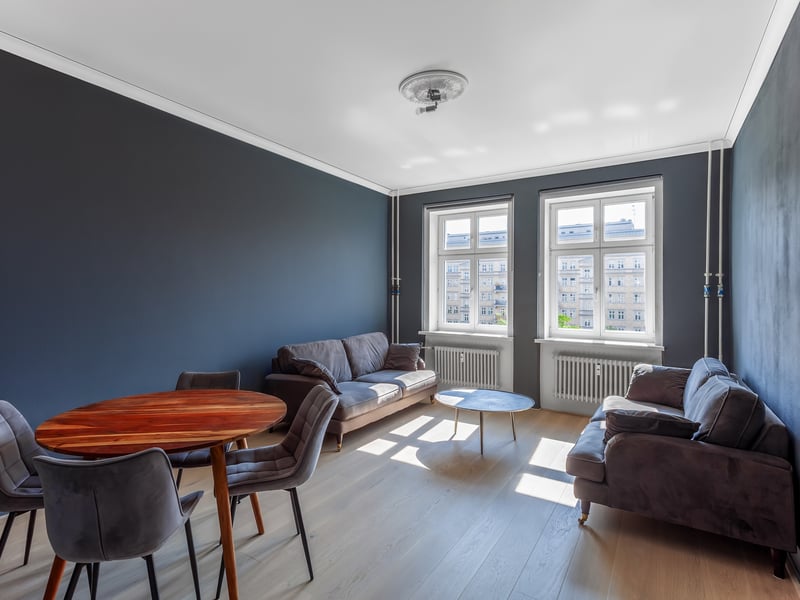
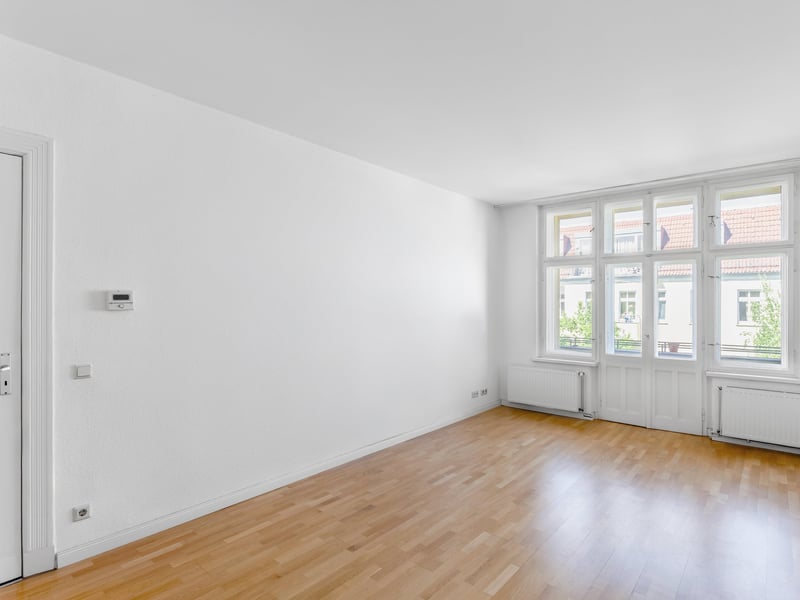
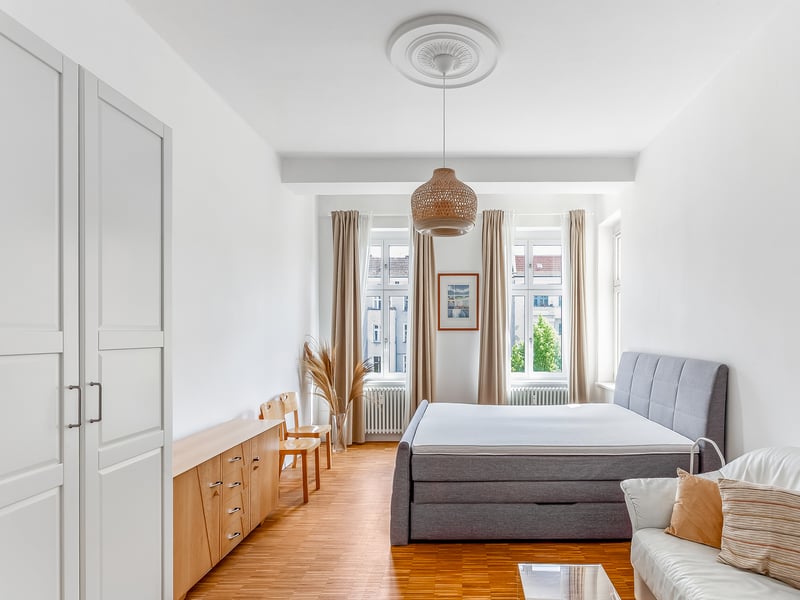
Friedrichshain has an above-average number of small apartments, which fits the high share of single households and shared flats. The following overview shows how the stock is distributed across the size classes.
| Size class | Count | Share |
|---|---|---|
| Unter 40 m² | 10,486 | 13 % |
| 40-59 m² | 24,479 | 31 % |
| 60-79 m² | 24,198 | 31 % |
| 80-99 m² | 11,788 | 15 % |
| 100-119 m² | 4,530 | 6 % |
| 120-139 m² | 1,643 | 2 % |
| 140-159 m² | 587 | <1 % |
| 160-179 m² | 280 | <1 % |
| 180-199 m² | 113 | <1 % |
| 200+ m² | 158 | <1 % |
The use of the stock is also informative for the social mix. The district is strongly shaped by tenants, and the share of owner-occupied residential property is low.
| Type of use | Count | Share |
|---|---|---|
| Rented | 69,067 | 87 % |
| Owner-occupied | 7,634 | 10 % |
| Vacant | 1,418 | 2 % |
| Commercial | 1,519 | 2 % |
Construction activity has been high since the mid-2010s and, alongside large-volume new development projects on the water, has also included numerous renovations of existing stock. In the densely built inner-city quarter, new development arises predominantly through infill and through the development of former railway and industrial sites.
| Period | Apartment balance |
|---|---|
| 2021 | 246 apartments |
| 2022 | 725 apartments |
| 2023 | 291 apartments |
| 2024 | 736 apartments |
Transport and infrastructure
Friedrichshain is closely linked to the local transport network. The U5 crosses the district along Karl-Marx- and Frankfurter Allee with the stations Strausberger Platz, Weberwiese, Frankfurter Tor, Samariterstraße and Frankfurter Allee and connects it westward via Alexanderplatz to the Hauptbahnhof and eastward to Hönow. At the south-western edge, the U1 and U3 run across the Oberbaumbrücke and the Warschauer Straße station to Kreuzberg.
The S-Bahn serves the district via the Stadtbahn with the Ostbahnhof and the Warschauer Straße station as well as via the Ringbahn with the stations Frankfurter Allee, Storkower Straße and Landsberger Allee. The central hub is the Ostkreuz station, where the Ringbahn, Stadtbahn and regional services cross and which, after its rebuild, ranks among the busiest stations in Berlin. Several tram lines, among them the M10 to Warschauer Straße and the M13, as well as a dense bus network, complete the access.
The Ostbahnhof, formerly the central long-distance station of East Berlin, links Friedrichshain to regional and long-distance services, with connections towards Poland and Eastern Europe among others. Via the Stadtbahn, the Berlin Hauptbahnhof can be reached in a few minutes.
Friedrichshain is shaped by short distances; many everyday destinations can be reached on foot or by bike. A riverside path runs along the Spree, and the main axes of Karl-Marx-Allee and Frankfurter Allee have cycling infrastructure. The high building density and the traffic volume at the going-out strips remain a challenge for transport planning.
Primary and secondary schools are spread across the residential Kieze, complemented by numerous day-care centres, demand for which is high in the young quarters. Local supply runs through the shops along Frankfurter Allee, the Ring-Center as a larger shopping centre and the weekly markets at Boxhagener Platz and the Ostbahnhof.
The most important green space is the Volkspark Friedrichshain in the north. To this are added the bank of the Spree, the waterside locations on the Stralau peninsula at the Rummelsburger Bucht, as well as smaller neighbourhood parks such as Traveplatz and Forckenbeckplatz. Measured against its density, Friedrichshain is rather poor in green space, and the existing facilities are used intensively accordingly.
Who Friedrichshain suits
- International creatives and tech professionals: Mediaspree, the Osthafen and the Uber Platz make the district a workplace for a young, international working population; short distances and many small apartments fit with this. The supply is predominantly rental.
- Students and shared-flat residents: A young average age, a high share of shared flats and the density of gastronomy, culture and nightlife shape this segment; shareable period apartments are in demand.
- Owner-occupiers and first-time buyers on the water: The new development quarters on the Stralau peninsula and along the Spree offer residential property close to the water; in the Gründerzeit stock, owner-occupied property remains scarce.
- Buy-to-let investors in apartment buildings: An extensive Gründerzeit apartment building stock with stable rental demand; conservation areas under section 172 of the Building Code regulate conversion and modernisation.