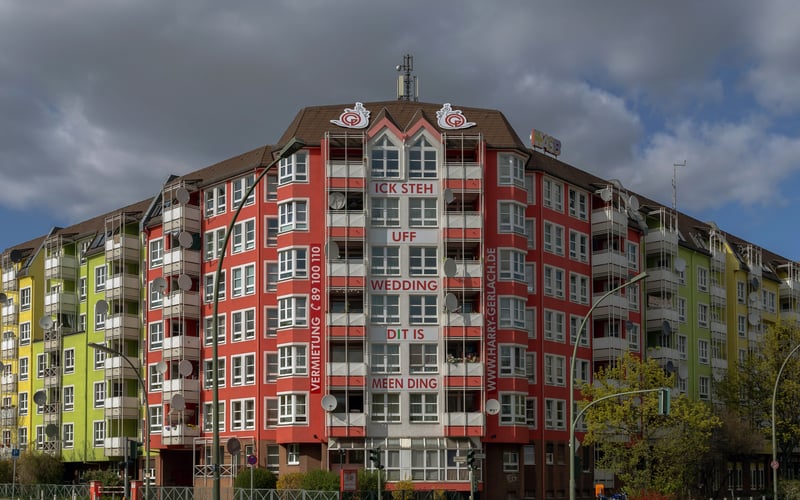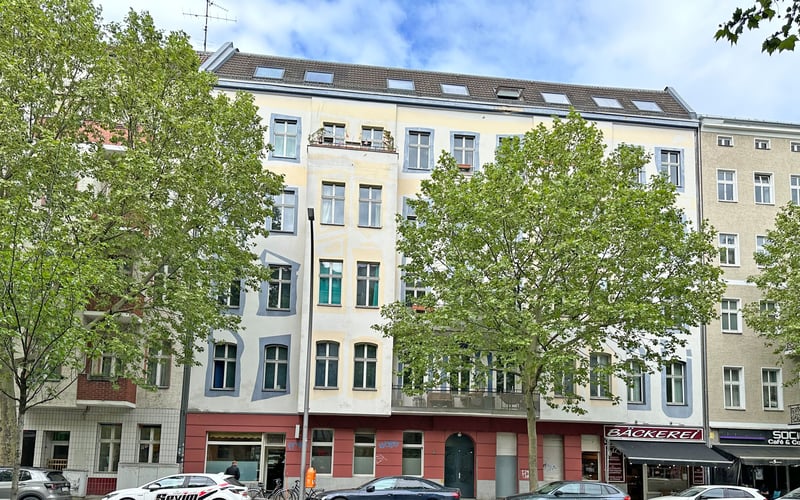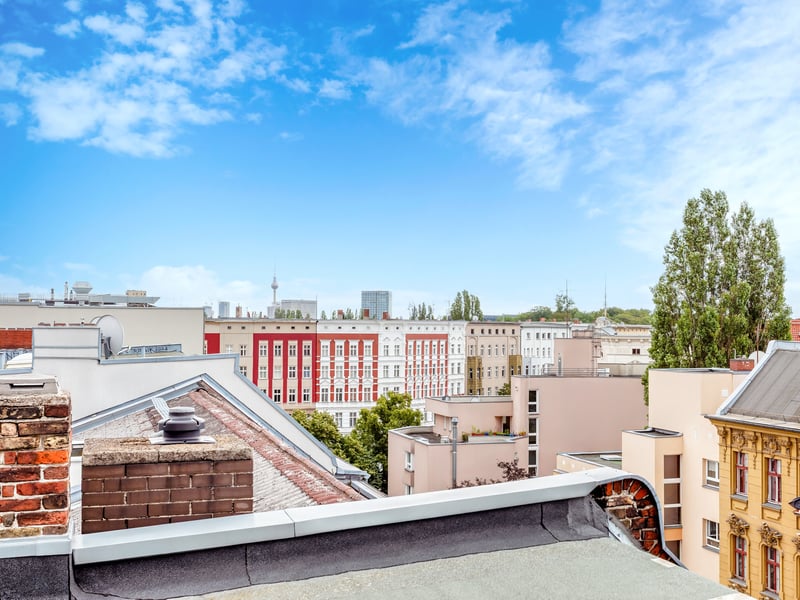


Character and identity
Tiergarten is a district in the borough of Mitte, located at around 52.51 North and 13.35 East, with an area of 5.16 square kilometres. More than a third of it is parkland. The Großer Tiergarten, one of the largest inner-city parks in Germany and a former royal hunting ground, gives the district its name and its shape. What is not park is spread across the government quarter in the north, the Kulturforum and the edge of Potsdamer Platz in the east, and the residential quarters in the south. The district comes to 16,349 residents, 8,208 households and 8,624 apartments, spread across only 586 buildings. This makes Tiergarten one of the smallest residential locations in Berlin.
This mix makes the place a special case. Few Berlin districts carry so much national grandeur and at the same time so little everyday living as Tiergarten. By day, tourists, employees of the ministries and concert-goers stream in; by evening, life withdraws into the comparatively narrow residential quarters south of the Landwehrkanal. Anyone living here lives between grandeur and park, often in sight of an embassy or a federal building.
Location quality is the defining factor. From hardly any residential quarter are the Reichstag, the Philharmonie and the park all within walking distance at the same time. That is exactly what makes the housing market both sought-after and manageable: there is simply little substance that is traded. Tiergarten is not a district to pass through, but one you move into deliberately and where you stay.
History and change
The Großer Tiergarten began as a hunting ground of the Brandenburg electors outside the gates of the city. In the 18th and 19th centuries it was reshaped into a public park; formative was the garden architect Peter Joseph Lenné, who from 1833 gave the park the form of lawns, watercourses and curving paths that is still visible today. Around it, a refined residential and embassy quarter grew up during the imperial era.
The Second World War hit Tiergarten hard. Bombing destroyed large parts of the development, and the National Socialist „Germania“ plans had already cleared whole streets for a planned north-south axis beforehand. After 1945, freezing Berliners felled the park almost entirely to heat their homes and laid out vegetable beds among the stumps. Reforestation began in 1949 and dragged on for years. Anyone walking through the dense greenery today stands in a forest that is younger than many of its strollers.
The division wrote the district its second defining trait. Tiergarten lay in the British sector, directly on the border with the east. Potsdamer Platz, before the war one of the busiest squares in Europe, became wasteland on the wall strip. After the fall of the Wall, the peripheral location turned into a central one. On the Spreebogen wasteland, the new government quarter arose from 1997, the Reichstag received its glass dome, and at Potsdamer Platz a completely new quarter rose from the ground in the 1990s. In administrative terms, the until then independent borough of Tiergarten was added to the borough of Mitte in 2001. In southern Tiergarten, a milieu protection area with a conservation statute under section 172 of the Building Code applies today, restricting the conversion of rental apartments into condominiums.
Sights
Tiergarten carries an unusually dense stock of buildings of national rank. In the north, the government quarter at the Spreebogen sets the opening: the Reichstag, the Bundeskanzleramt and the Bundestag buildings group around the river bend, and a stone's throw away stands Schloss Bellevue as the official residence of the Federal President. At the edge of the park, the Haus der Kulturen der Welt, called the „Pregnant Oyster“ because of its curved roof, marks post-war modernism.
In the park itself, much revolves around the Siegessäule at the Großer Stern, from whose viewing platform the axis of Straße des 17. Juni opens eastward to the Brandenburg Gate. To this are added the Soviet War Memorial, the Englischer Garten and the Rosengarten. At the south-western corner lies the Zoologischer Garten, the oldest zoo in Germany, with its aquarium.
The cultural focus is set by the Kulturforum at the eastern edge of the park. Here the Philharmonie by Hans Scharoun, the Neue Nationalgalerie by Ludwig Mies van der Rohe, the Staatsbibliothek and the Gemäldegalerie stand close together in a tight space. A few hundred metres further on, the high-rise ensemble of the post-reunification years begins at Potsdamer Platz. This density of institutions explains why Tiergarten draws so much public by day and becomes so quiet in the evening.
Popular Kieze in Tiergarten
The actual living concentrates in a few quarters, above all south of the Landwehrkanal. They differ markedly in development and atmosphere.
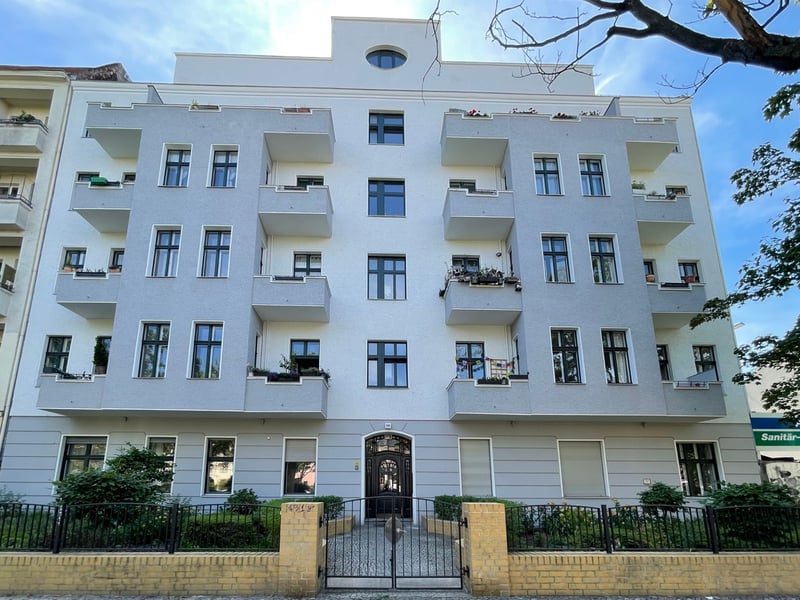
- Tiergarten-Süd (Lützowviertel): The residential centre of the district around Lützowplatz and Lützowstraße. Here the period and post-war stock is concentrated, and here milieu protection applies. A quarter with a high tenant share and an established neighbourhood.
- Diplomatenviertel: Along Tiergartenstraße south of the park, the embassies line up, many in the pre-war architecture of the 1930s, others as striking new developments of the post-reunification period. Living here takes place in small quantities and in exposed locations.
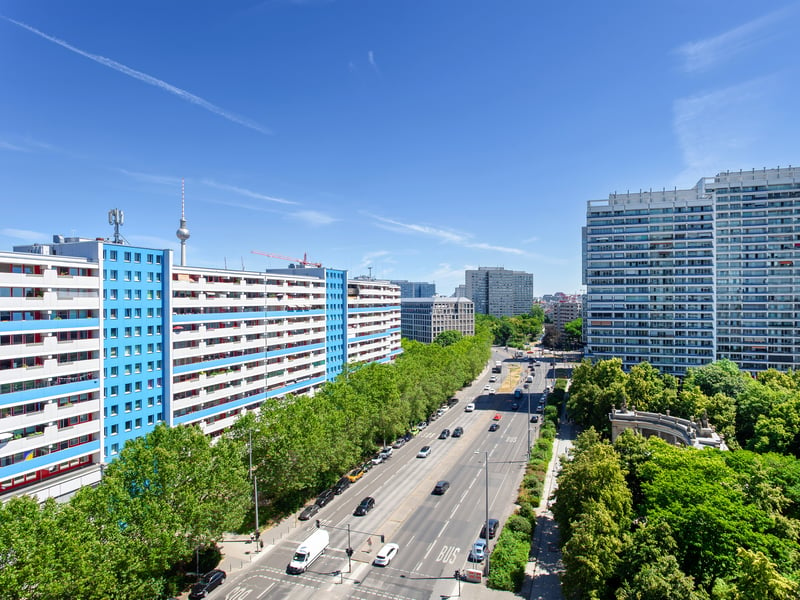
- Am Gleisdreieck and Flottwellstraße: At the transition to Schöneberg, the youngest residential quarter of the district arose with the Park am Gleisdreieck and the adjoining new developments, shaped by contemporary architecture and proximity to the park.
- Reichpietschufer and Landwehrkanal: The waterside locations on the northern bank of the canal are thinly populated and heavily interspersed with office and institutional buildings, but offer individual high-quality residential addresses.
Scene and everyday life
Tiergarten has no classic Kiez life with a dense shopping street; the park and the large buildings see to that. Everyday life plays out at the edges and reaches strongly into the neighbourhood. For shopping, eating and going out, people orient themselves towards Schöneberg, towards the north of Charlottenburg or into neighbouring Mitte.
In the district itself, the park shapes leisure life. On summer weekends, the lawn at the Englischer Garten becomes a barbecue zone, you can go boating on the Neuer See, and the café on the bank is one of the established addresses. Culturally, the bar is set high: the Philharmonie and the houses of the Kulturforum draw a supraregional audience, and the Haus der Kulturen der Welt focuses on international programmes. Anyone looking for gastronomy and nightlife finds it rather at the edge, for example around Potsdamer Straße, which reaches into the district from the south and has filled up with galleries and venues in recent years.
Who lives in Tiergarten
According to the Amt für Statistik Berlin-Brandenburg, Tiergarten counts around 16,300 residents (as of the end of 2025) and is thus among the least populous districts in the city. The resident population is decidedly international: a good 41 percent hold no German passport, and around two thirds have a migration background. That is considerably more than the Berlin average and shapes the streetscape as much as the demand for housing.
| Age group | Count | Share |
|---|---|---|
| under 6 | 776 | 5 % |
| 6–15 | 1,033 | 6 % |
| 15–18 | 348 | 2 % |
| 18–27 | 1,910 | 12 % |
| 27–45 | 5,853 | 36 % |
| 45–55 | 1,930 | 12 % |
| 55–65 | 1,925 | 12 % |
| 65+ | 2,574 | 16 % |
The age structure shows a clear focus in the working age. The group of 27- to 44-year-olds is by far the largest and makes up more than a third of the residents. Families with children are rarer, and the under-18s account for only about an eighth. At the same time, a noticeable older cohort stands out: those over 65 come to around a sixth and are often long-standing tenants who have known the quarter for decades.
| Household size | Count | Share |
|---|---|---|
| 1 person | 5,496 | 67 % |
| 2 people | 1,452 | 18 % |
| 3 people | 581 | 7 % |
| 4 people | 389 | 5 % |
| 5 people | 138 | 2 % |
| 6+ people | 152 | 2 % |
The households are correspondingly small. One- and two-person households dominate, and large households are the exception. This fits the housing stock, which consists predominantly of small units, and explains why compact floor plans are so sought-after here.
| Region of origin | Count | Share |
|---|---|---|
| EU | 2,551 | 32 % |
| Turkey | 1,007 | 13 % |
| Russia | 788 | 10 % |
| China | 527 | 7 % |
| Ukraine | 527 | 7 % |
| unassigned | 467 | 6 % |
| Syria | 389 | 5 % |
| India | 323 | 4 % |
| USA | 284 | 4 % |
| Iran | 275 | 3 % |
| Lebanon | 211 | 3 % |
| United Kingdom | 188 | 2 % |
| Iraq | 116 | 1 % |
| Vietnam | 101 | 1 % |
| Kazakhstan | 79 | 1 % |
| Afghanistan | 66 | <1 % |
Among the origins of residents with a migration background, the European Union is far ahead, followed by Turkey and the Russian Federation as long-established groups. Behind them come China, Ukraine and Syria. The composition reflects two layers: an established immigration of earlier decades and a younger movement driven more strongly by education and labour migration.
Who is drawn to Tiergarten
Migration data show who actually heads for a district and who leaves it. For Tiergarten, they paint the picture of a place that grows internationally and exchanges closely with its neighbours within the city.
| # | Country | Inflow | Outflow | Net |
|---|---|---|---|---|
| 1 | Indien | 140 | 70 | 70 |
| 2 | China | 103 | 65 | 38 |
| 3 | Russische Föderation | 57 | 25 | 32 |
| 4 | Türkei | 57 | 23 | 34 |
| 5 | Ukraine | 46 | 57 | -11 |
| 6 | Islamische Republik Iran | 37 | 19 | 18 |
| 7 | Vereinigte Staaten | 35 | 22 | 13 |
| – | Deutschland | 309 | 325 | -16 |
Across the city border, the most new residents in 2024 moved in from India and China, both with a clearly positive balance, followed by Turkey, the Russian Federation and Iran. This points to education and knowledge migration, that is, to skilled workers, researchers and students who are looking for a central, well-connected address. The contrast with the existing stock is notable: while the established resident population is shaped by the EU, Turkey and Russia, the most recent arrivals come increasingly from Asia.
| # | District | People |
|---|---|---|
| 1 | Mitte | 97 |
| 2 | Schöneberg | 89 |
| 3 | Kreuzberg | 83 |
| 4 | Charlottenburg | 82 |
| 5 | Wilmersdorf | 63 |
Within Berlin, the inflow draws almost exclusively from the central western and central locations. Mitte, Schöneberg, Kreuzberg, Charlottenburg and Wilmersdorf provide the largest source areas. Tiergarten therefore recruits its new residents from the immediate surroundings, not from the outer boroughs.
| # | District | People |
|---|---|---|
| 1 | Schöneberg | 129 |
| 2 | Mitte | 114 |
| 3 | Charlottenburg | 106 |
| 4 | Wilmersdorf | 82 |
| 5 | Moabit | 78 |
In terms of out-migration, the same close web appears, with one peculiarity: on balance, Tiergarten loses residents to Schöneberg, to which noticeably more people move than come from there. Anyone looking for more space or a bit more everyday Kiez life evidently shifts to the neighbouring quarter. The exchange remains small-scale in both directions, and the range of action of Tiergarten residents usually ends a few kilometres before their own front door.
Buildings and apartments
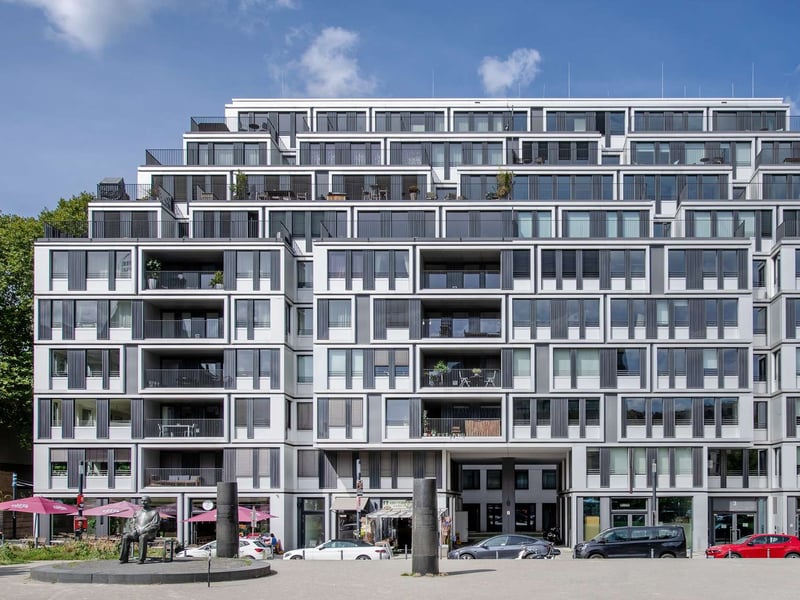
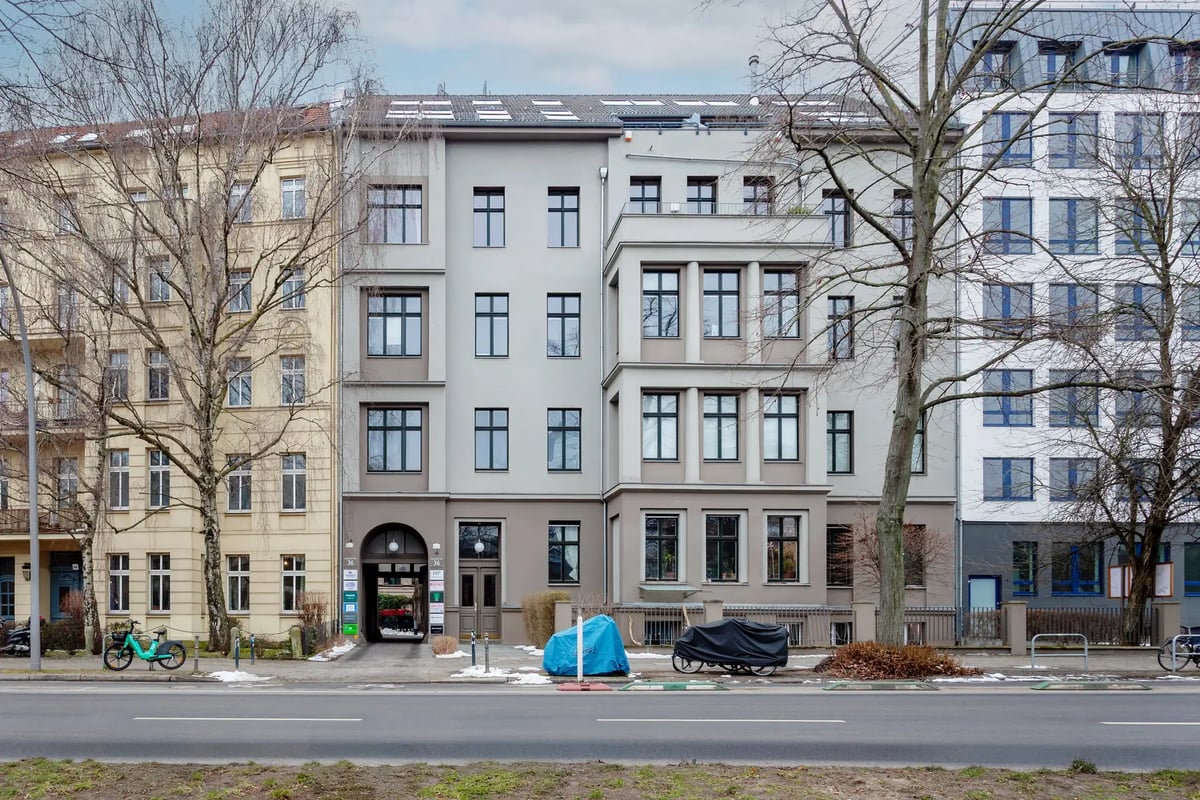
The housing stock is small and goes back to only 586 buildings. The building type is determined by the closed construction method: roughly three out of five houses are terraced, that is, part of perimeter block rows, and the rest is spread across detached and individual other buildings. This produces the typical compact inner-city structure with multi-storey houses on a few streets.
| Size class | Count | Share |
|---|---|---|
| Unter 40 m² | 1,451 | 17 % |
| 40-59 m² | 2,404 | 28 % |
| 60-79 m² | 2,181 | 25 % |
| 80-99 m² | 1,103 | 13 % |
| 100-119 m² | 576 | 7 % |
| 120-139 m² | 373 | 4 % |
| 140-159 m² | 228 | 3 % |
| 160-179 m² | 97 | 1 % |
| 180-199 m² | 91 | 1 % |
| 200+ m² | 117 | 1 % |
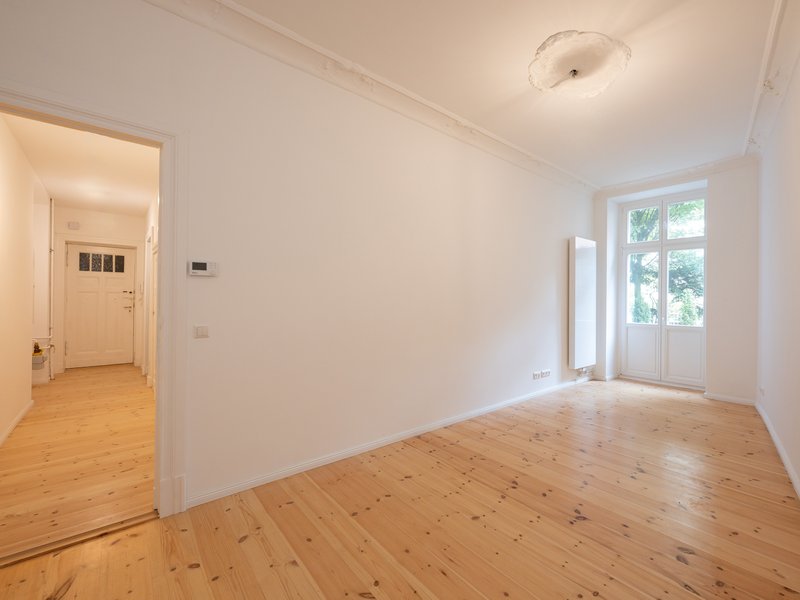
With the apartment sizes, the focus lies clearly at the lower end. About two thirds of all apartments are smaller than 80 square metres, and the largest single segment is formed by the 40- to 59-square-metre apartments. At the same time, there is a small but noticeable stock of large apartments beyond 120 square metres, often in the better locations towards the park. Tiergarten is thus predominantly a district for singles and couples, with a narrow peak for upmarket family living.
| Type of use | Count | Share |
|---|---|---|
| Rented | 7,541 | 86 % |
| Owner-occupied | 823 | 9 % |
| Vacant | 213 | 2 % |
| Commercial | 148 | 2 % |
The use structure stands out most clearly. The great majority of apartments are rented, and only a scant tenth are occupied by owners themselves. Vacancy is low. This pronounced tenant character explains why milieu protection takes effect in the south of the district and why freely available residential property is a rarity here. New development arises almost only where larger areas were available, for example at the Gleisdreieck and on Flottwellstraße. In the established stock, construction activity remains the exception for reasons of space.
Transport and infrastructure
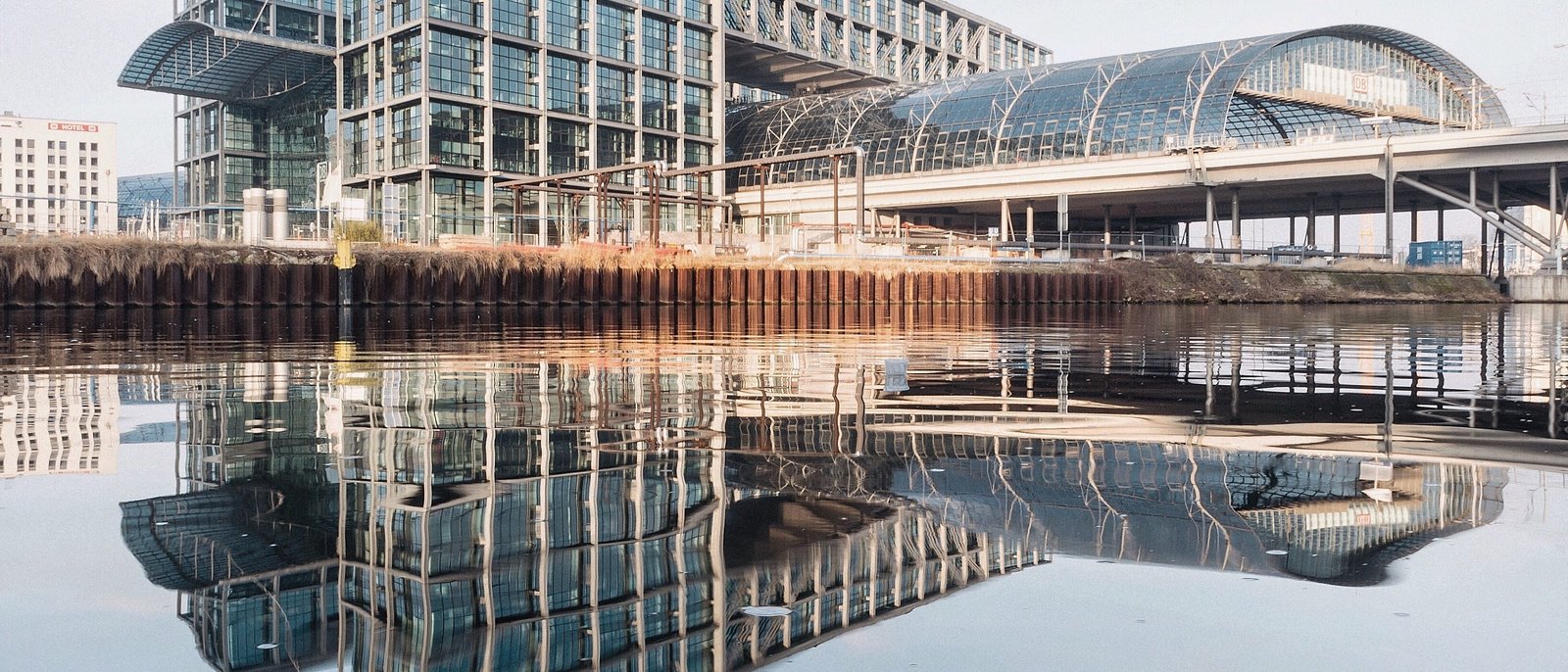
In terms of transport, Tiergarten is excellently served, above all at the edges. In the east, the Potsdamer Platz station links regional, S- and U-Bahn; in the south, the Kurfürstenstraße U-Bahn station connects the Lützowviertel, and the U2 line threads out to the south-west via Mendelssohn-Bartholdy-Park and Gleisdreieck. The Berlin Hauptbahnhof lies at the northern edge beyond the Spree in immediate proximity and provides the long-distance connection. The urban motorway touches the district in the south, and the major east-west and north-south axes, among them Straße des 17. Juni and the Entlastungsstraße, cross the park.
Within the district, the bicycle is often the fastest means of transport, because the routes through the park have few junctions and are green. From the residential quarters, both the park and the Kulturforum can be reached on foot. With local supply, on the other hand, Tiergarten is rather thinly served: supermarkets and shops for daily needs concentrate on a few streets in the south, and for the larger offering people orient themselves towards Schöneberg or Mitte. Schools and day-care centres are present, but manageable because of the low family share. By far the most important green space is the Großer Tiergarten itself, which gives every residential quarter a park location within walking distance.
Who Tiergarten suits
- International specialists and executives: A high share of foreign residents and inflows carried by India, China and the USA, plus the central location between the government quarter, the Hauptbahnhof and Potsdamer Platz. The supply is small and predominantly rental.
- Urban singles and couples without children: Small apartments, small households and the dominant age group of 27- to 44-year-olds fit residents who value the park, culture and the inner city; for families, large apartments and everyday infrastructure are thin.
- Owner-occupiers in a premium location: The narrow stock of large apartments beyond 120 m2, often towards the park, serves buyers wanting a representative, quiet address; owner-occupied property is the exception.
- Buy-to-let investors with a long horizon: A pronounced tenant character, scarce supply and milieu protection in the south appeal to stock holders who bet on location and value stability; apartment buildings are rare and rarely change owners.